
Startups & support@
When should a startup make its first support hire, and what to run until then? (the $45–65k question)
A first support hire costs roughly $45,000 to $65,000 a year. Before you post the job, find out which emails a person actually has to answer. The founder's inbox already holds that list.
Short answer
Hire when the work that truly needs a person fills most of a working week, week after week, and your reply-time promises start slipping. Count it first. A US customer service rep earns a $44,770 median wage (BLS, May 2025); Help Scout's calculator assumes $67,600 fully loaded. Until then, let software answer routine questions from your written facts and hand the rest to a founder with a stated reply time. The handed-off pile becomes the job description.
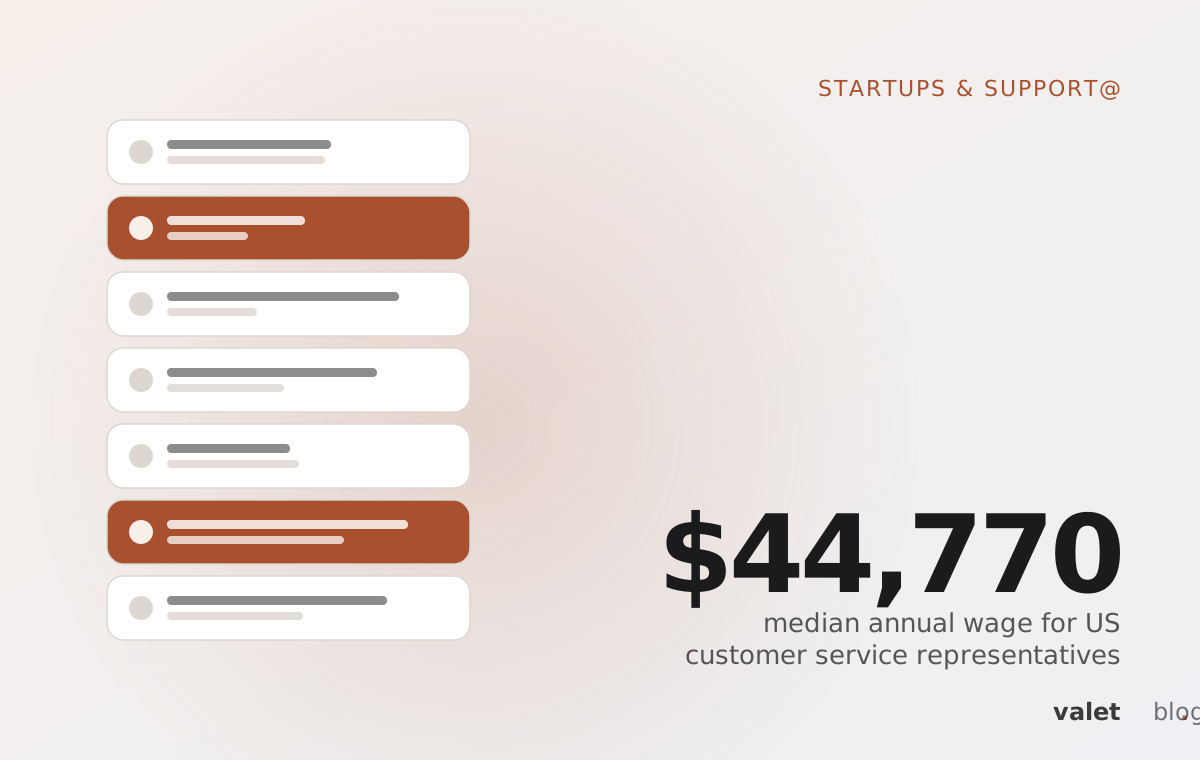
$44,770
median annual wage for US customer service representatives
BLS Occupational Outlook Handbook, May 2025 data
$67,600
per support rep per year, the default in Help Scout's pricing calculator
helpscout.com/pricing, checked 1 Oct 2026 (vendor assumption)
two-thirds
of Klarna's customer inquiries still handled by its chatbot after it re-hired humans
Customer Experience Dive, 9 May 2025
Make the first support hire when the conversations that truly need a person fill most of a working week, for weeks in a row, and founders start missing the reply times they promised. Before that point, a hire is a salary paid to answer questions your written facts already answer. The money is real. The US median wage for a customer service representative is $44,770 a year (May 2025)1. Help Scout's pricing calculator assumes $67,600 per rep once costs are loaded2. Count the human-only work first. That count is the job description.
What does founder-led support look like at 11:40 on a Tuesday night?#
Founder-led support usually happens in the gaps between other work, and the gaps get later as the company grows. The scene below is an illustration, built from what founders describe in public threads. It is not a real person.
The laptop sits on a kitchen table next to a mug that went cold at nine. The founder has a pull request open in one tab and support@ in the other. Fourteen unread. Three ask how to export a CSV, which the docs explain in a paragraph with a screenshot. One asks for a refund because the card was charged the day after a cancel click. One is from a customer in Osaka, sent four hours ago, about an error that only shows up on their account. The founder answers the three export questions first, because they are quick. It is 23:52 when the Osaka email gets read.
The parts of that scene are not invented. A founder in r/EntrepreneurRideAlong (20+ comments, mid-2026) wrote: "I am one person. I write code, I do support, I handle billing issues." A thread in r/indiehackers about expanding abroad opens with a customer in Japan who "has problem at 3am." The Osaka email is the one that matters, and it is the one that waits.
What does doing your own support cost a founder?#
Founder time on support@ costs more than it looks, because it is paid in the hours that would have gone to building and selling. No founder has published a full time log that we could find. So here is an illustration with the assumptions shown.
| Input | Assumption | Result |
|---|---|---|
| Emails a day | 15 | |
| Minutes each, including reading and switching back | 6 | 90 minutes a day |
| Working days a year | 260 | 390 hours a year |
| Value of a founder hour | $100–150 | $39,000–58,500 a year |
Change any line to match your inbox. The point is the order of magnitude, which lands close to a support salary.
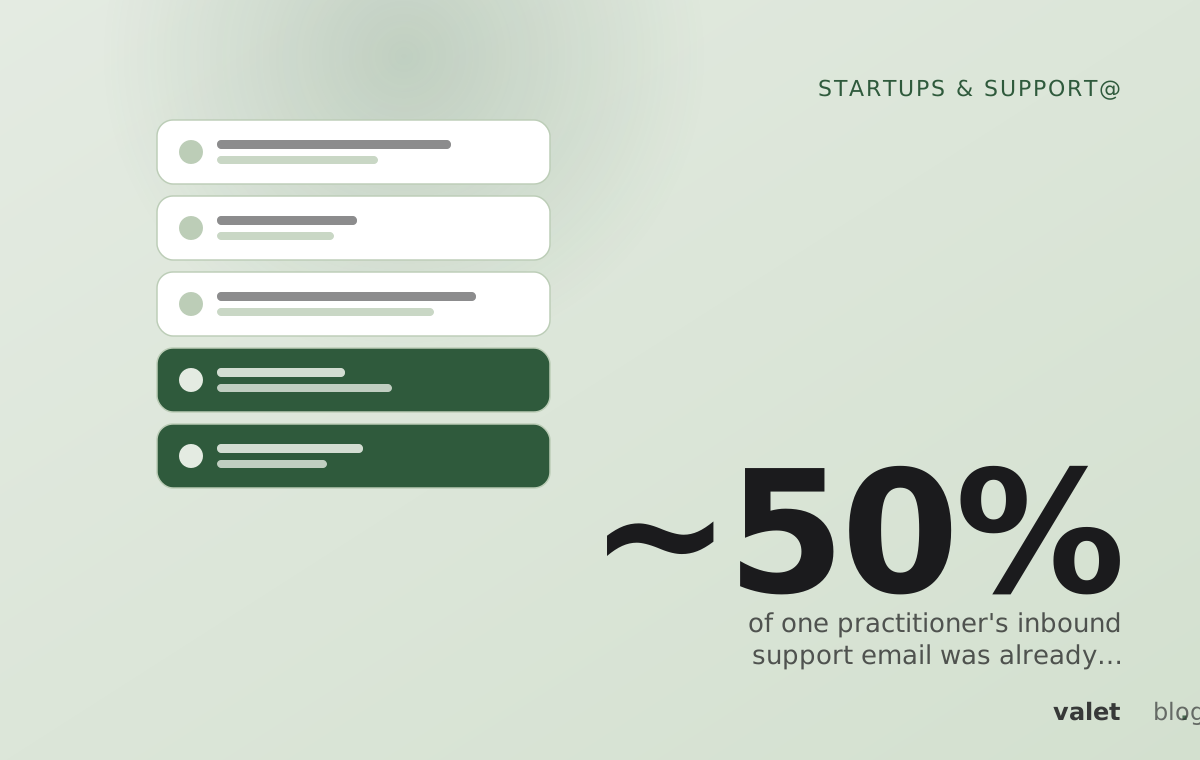
The cost that does not fit in a table is the switching. The founder in the scene answered three easy questions before the hard one, because easy work feels like progress at midnight. Most of the inbox is easy. A former support lead who ran Fin rollouts wrote on Hacker News in June 2026 that "~50% of the inbounds I receive are fully written out in plain language in an FAQ"5. That is one person's inbox. Yours will differ. It is still a reason to measure before you hire.
Why do some founders keep answering support themselves on purpose?#
Some founders keep support because it is the best seat in the company for hearing what customers need. In February 2026, one founder on Hacker News described a $499-a-month offer that "includes hands-on founder support, not just software access," with "direct founder access (me, not support)" listed as a feature4. For that business, the founder's attention is part of what customers pay for.
There is craft in it too. A founder who answers support@ learns which screen confuses people, which plan name misleads, which error message nobody understands. A popular comment in r/SaaS (30+ comments, August 2026) put the order of fixes plainly: "Repeated questions -> think about product design first, then if not add FAQs." In the same June 2026 Hacker News thread, another commenter warned: "There is a huge signal in customer support. Don't just waste it by slapping AI on it"5.
Laura Roeder's 2022 post "Bootstrapped Founder? Don't Do Your Own Support." still ranks for these searches, and its title gives the usual advice. The open question is when that point arrives, and what sits in between.
What can run in between: founder, then an agent with a handoff, then a hire#
The middle step for a small startup is software that answers routine questions and hands everything else to a founder, with a stated time for the reply. It does not replace the founder's judgement. It moves the easy half out of the founder's evening so the hard half gets read first.
The handoff is where this goes wrong when it goes wrong. In Gorgias platform data (accounts with 200+ AI-touched tickets, October 2025 to April 2026), 55% of AI-touched tickets went to a human, and about a third of those never got a human reply8. Those are e-commerce numbers, but the failure is the same in SaaS: the customer is told someone will help, and nobody owns the promise.
Customers are clear about the terms. Five9 surveyed 1,006 consumers in the US, UK and Canada and found 72% open to AI if they can escalate to a human when needed9. Klarna learned this at scale. In May 2025 its CEO said "it's so critical that you are clear to your customer that there will be always a human if you want," and the company began recruiting for what he called "an Uber-type customer service setup." The chatbot still handles two-thirds of all customer inquiries3.
For a three-person startup, the in-between setup has four parts:
- A written facts page. Plans, prices, limits, refund policy, known bugs, status page. Software answers only from it.
- A never list. Refunds outside policy, discounts, security claims, roadmap dates and angry customers go to a founder.
- A stated reply time. Every handoff tells the customer who will answer and by when, in their time zone.
- A record of every reply. What was asked, what source was used, whether it was handed off, and when a person answered.
On cost: three Intercom seats at $29 plus 500 Fin outcomes at $0.99 each comes to about $582 a month, or roughly $7,000 a year, at list prices checked on 1 October 202667. That is one example of a per-outcome tool, not a recommendation. For the runbook version of this setup, see how to handle support@ as a solo or 3-person SaaS founder.
What do your handoff records say the hire would do?#
Handoff records answer the hiring question better than a gut feeling, because they list the conversations software could not or should not finish. After 30 days of running the in-between setup, the founder has a pile of handed-off threads. Sorted, that pile usually falls into a few kinds of work: billing exceptions, bugs that need reproducing, customers who are upset, onboarding help that needs a call.
That pile is the honest job description. A generic support job ad asks for someone to "own the inbox." The records may say something narrower: someone who can read logs and reproduce bugs, or someone who can calm a customer and decide a refund within policy. Those are different hires with different pay. You only know which one you need after you have counted.
| Step | What to write down | How to use it |
|---|---|---|
| 1. Count handoffs | Every thread that needed a person in the last 30 days, by kind: billing exception, bug, upset customer, onboarding, security or legal, other | If "other" is more than one in ten, add a kind |
| 2. Time them | Average minutes a founder spent per handed-off thread, per kind | Threads × minutes ÷ 4.3 = human hours a week |
| 3. Check promises | How many stated reply times were missed each week | Missed promises are the clearest sign the founders are out of hours |
| 4. Mark fixable causes | Which handoffs come from one product problem (a confusing screen, a billing bug) | Fix those before hiring. They should shrink the count |
| 5. Read the result | Under 5 human hours a week: founders keep it. 5 to 15: share a rotation between founders and fix the top causes. Over 15 to 20 for two months running, or promises missed every week: write the job ad | These are starting thresholds, not benchmarks. Move them to fit your team |
| 6. Write the job from the pile | The two or three kinds that take most of the hours | Those kinds are the role. Skills, pay and hours follow from them |
Job-ad starter, written from the handoff count:
"Last month our customers needed a person for [kind 1: N threads],
[kind 2: N threads] and [kind 3: N threads]. This role owns those.
Routine questions are answered from our written facts; you will
own the facts page too, and every reply-by time we promise."
What changes in a founder's week, and what does not?#
The in-between setup changes the order in which the founder meets the inbox. The export questions stop arriving at midnight. The refund email arrives already marked as a refund, with the customer told when they will hear back. The Osaka email is at the top of the list, not under three easy ones.
Some things do not change. The founder still decides refunds. The founder still reads the angry email, and should. The facts page goes stale the day pricing changes unless someone updates it that afternoon. And a bad week, an outage or a billing bug, still lands on the people who built the product. Software does not take the bad week. It only clears space so somebody can.
| Option | Rough yearly cost | What it buys | What it leaves |
|---|---|---|---|
| Founder answers everything | $39,000–58,500 of founder time (illustration above) | Closest contact with customers | Slow replies when building or selling; the hard emails wait behind easy ones |
| Agent with a handoff | About $7,000 at the example list prices above | Routine answers at any hour; a sorted pile for the founder | Every handed-off thread still needs a founder by the stated time |
| First support hire | $44,770 median wage; about $67,600 loaded in Help Scout's assumption | A person who owns the queue and the promises | Management time; the hire needs a facts page and a never list too |
Sources: BLS (May 2025)1; Help Scout calculator default2; Fin and Intercom list prices, 1 Oct 202667.
When is it too early or too late to hire for support?#
A first support hire is too early when most of the inbox is questions your docs already answer, because the new person spends the day pasting links. It is too late when founders miss promised reply times every week, or when the handoff pile is mostly upset customers. Upset customers are the ones who leave and say why in public. A thread in r/micro_saas titled "We lost 56 customers after I tried to save money with AI" drew 240+ comments in September 2026, and its stated fix was to "escalate to a human when it detects the AI is stuck on a loop."
Between those two points, the count decides. If the human-only hours keep growing after the top product causes are fixed, the company has outgrown founder support. That is good news, even if it does not feel like it at midnight. For the case against automating too much, read should a startup use AI for customer support. For how a handoff should behave, see what "never stuck with a bot" has to mean.
The founder in the illustration still answers the Osaka email that night. The hire is a few months off, maybe. The pile on the table says which kind of person to look for. It does not say when the money will be there.
Where Valet fits#
Valet is one way to run the in-between step without moving to a helpdesk. You forward support@ to a private Valet address, and replies go out from your own address once the domain is verified. Valet answers only from your own facts and never invents a price, discount or policy. Each topic is set to Autopilot, Ask me first or Always you; money, complaints and legal questions come to you with one-tap replies, and the customer is told when you will reply. Every reply says it is AI and comes with a Valet receipt showing what was asked, the rule used and the sources, which is the record the worksheet above needs. To see what your inbox holds today, start with the free lead check: forward 10 to 20 recent emails and see what went unanswered or stopped after one reply.
Questions people ask
When should a startup hire its first customer support person?
When the conversations that need a human add up to most of a working week for several weeks in a row, or when founders keep missing the reply times they promised. Count those conversations for 30 days before you decide.
How much does a first support hire cost?
The US Bureau of Labor Statistics puts the median wage for customer service representatives at $44,770 a year (May 2025). Taxes, benefits and tools push the full cost higher; Help Scout's pricing calculator assumes $67,600 per rep.
Is an AI agent a replacement for a first support hire?
No. It can take routine questions answered in your written facts. It should hand money, complaints and anything unclear to a person. Klarna's bot still handles two-thirds of inquiries, and the company went back to hiring humans for the rest.
What should the first support hire actually do?
Whatever your handoff records show needed a person: refunds and billing exceptions, bugs that need reproducing, angry customers, onboarding calls. Write the job from that list, not from a generic support job ad.
Sources
Confidence: H primary source checked · M credible secondary or reported · L vendor claim or single report. Reddit and forum items are quoted from public threads and summarised, not endorsed.
- Customer Service Representatives, Occupational Outlook Handbook · U.S. Bureau of Labor Statistics · 2025-05 H
- Help Scout pricing (cost calculator) · Help Scout · 2026-10-01 L
- Klarna reinvests in human talent for customer service after AI chatbot push · Customer Experience Dive · 2025-05-09 H
- Hacker News comment thread, item 47111029 · Hacker News · 2026-02 H
- Hacker News discussion thread, item 48540126 (Salesforce and Fin) · Hacker News · 2026-06 H
- Fin pricing · Fin (formerly Intercom) · 2026-10-01 H
- Intercom pricing · Intercom · 2026-10-01 H
- The cheapest ticket is the one a human never touches · Gorgias Ecom Lab · 2026 H
- New Five9 Research Reveals Balancing AI with Human Connection is Key to Winning Customer Experience · Five9 · 2025-03-13 H
How to cite this page
Cite this page
Valet, "When should a startup make its first support hire, and what to run until then?", valet.team, October 2026.
Keep reading
 Startups & support@Should a startup use AI for customer support? What founders who lost customers say, and the three missing controlsCustomers accept AI support when they can reach a person. The failures that cost startups customers trace to three missing controls, not to the model.Data desk · 11 min · 1 October 2026
 Startups & support@How to handle support@ as a solo or 3-person SaaS founder (without hiring, and without a bot that traps people)Sort support@ into four categories, give each a written promise and an automation level, and check the handoffs every week. Here is the runbook, plus the six ways it breaks.Playbooks · 12 min · 1 October 2026
 Startups & support@An AI agent that answers vs one that finishes the job: what "acts" means for a small business, and the four controls that make it safeMost AI tools sold to small businesses answer the first message and stop. This piece defines what it means for an agent to finish the job, traces where answer-only tools lose the inquiry, and sets out the four controls that make acting safe.Technical desk · 11 min · 1 October 2026