
Agencies
Wedding and event marketing agencies: the leads you generate die in the venue's inbox
Venue lead volume is rising and the lead-quality fight is loud. The signal agencies misread is quieter: what happens to an inquiry after the first reply. A map of the forces, three scenarios, and the indicators to watch.
Short answer
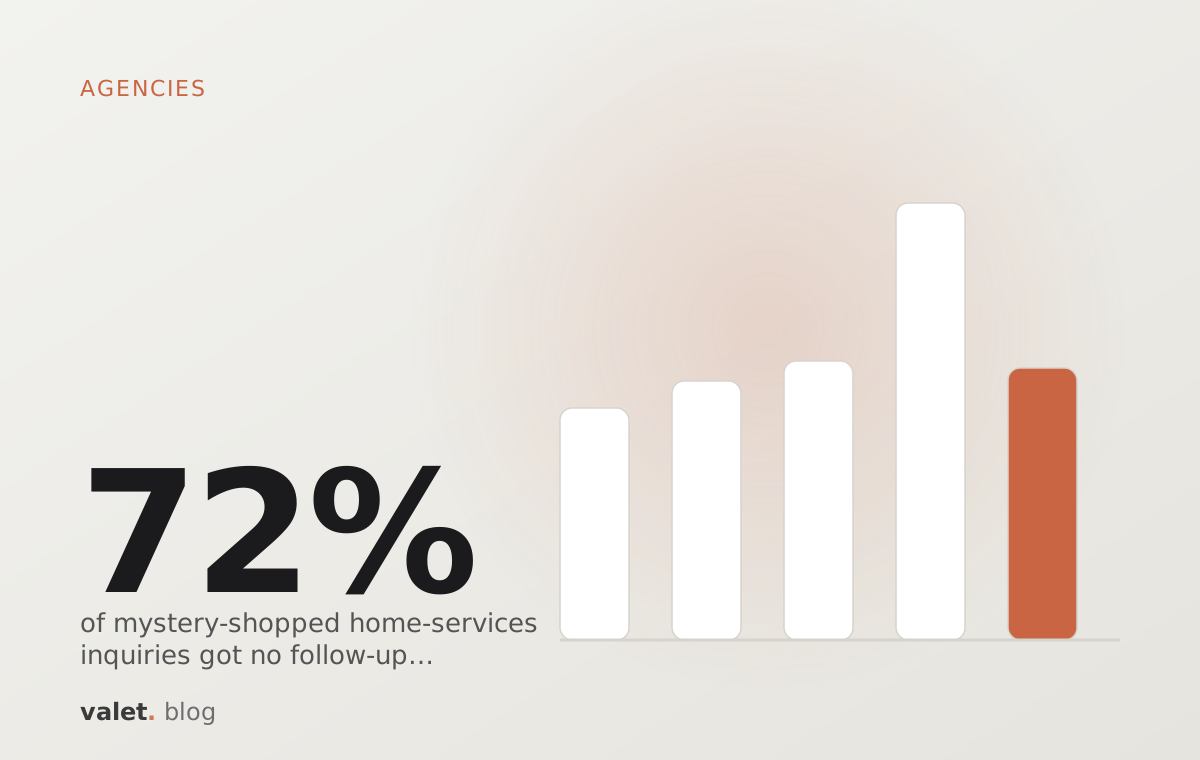
When a wedding venue's marketing produces inquiries but few bookings, the leak is often after the first reply, in the venue's inbox. No neutral study yet measures venue follow-up, but the nearest reference is stark: in Pied Piper's April 2026 mystery shop of 3,211 home-services locations, 72% of inquiries got no follow-up within 24 hours. Agencies should report median first response, the share offered a tour time, and follow-ups sent, next to lead volume.
72%
of mystery-shopped home-services inquiries got no follow-up within 24 hours
Pied Piper PSI, 3,211 locations, April 2026
1 in 5
qualified venue inquiries book, on Indigo's benchmark
Indigo Digital, August 2026
+9%
year-on-year growth in venue leads
Tripleseat Event Intelligence Report, 2026
When a venue's marketing produces inquiries but not bookings, the leak usually sits after the first reply, inside the venue's inbox, where the agency has no telemetry. No neutral study has yet measured venue follow-up. The nearest reference class is home services: in Pied Piper's April 2026 mystery shop of 3,211 locations, 72% of inquiries got no follow-up within 24 hours, and only 28% were offered an appointment1. If venues behave anything like that, more leads will not fix the booking line.
This piece maps the forces acting on venue lead handling, sets out three scenarios to April 2028, and names the indicators an agency can watch. It expires on a stated date.
The signal agencies are misreading#
The loud signals in venue marketing in 2026 are volume and quality. Tripleseat's 2026 Event Intelligence Report, built on 4.4 million events, puts venue leads up 9% year on year and names January as the top month2. The quality fight is louder still. In October 2025 Senator Grassley asked the FTC to look at The Knot after nearly 200 whistleblower complaints from vendors who said leads were "largely fake or otherwise lacked legitimacy"4.
The quieter signal is inside the platform's own defence. WeddingPro said in April 2025 that "less than 1% of leads" were marked as spam by vendors the previous year, and named ghosting as a reason real leads look fake: "when couples don't respond after initial contact, vendors perceive them as fake"3. Read that as a handling statement. A lead that goes quiet after one reply looks the same as a fake one, unless someone follows up.
Couples describe the other side. A thread in r/weddingplanning (30+ comments, c. 2022) carried the line "I can't even get a response to my inquiry emails"14. On a WeddingWire forum thread from May 2024, one couple's advice was: "If they don't respond after 5 business days, move on to some place else."15
What earlier shifts in lead handling tell us#
The historical base rate for small-business lead handling is poor, and it has not improved simply because leads got cheaper to generate. Three data points from different segments agree on the pattern.
| Study | Sample | Finding |
|---|---|---|
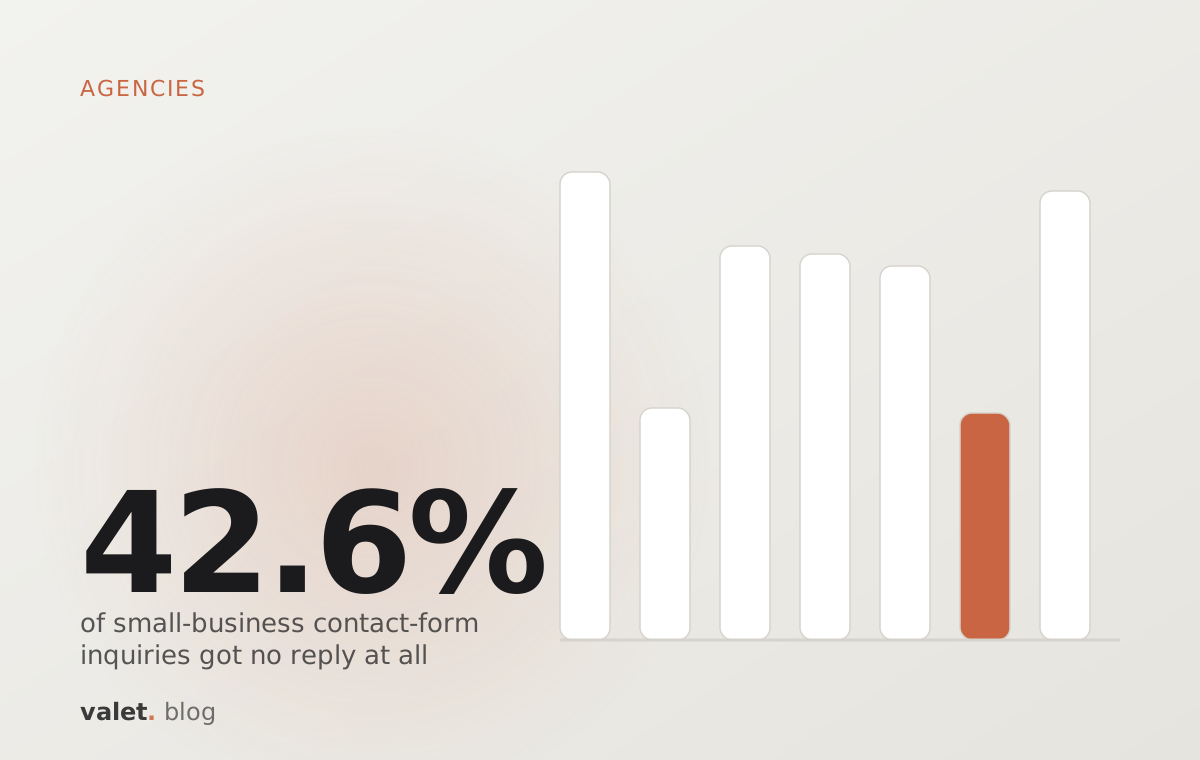
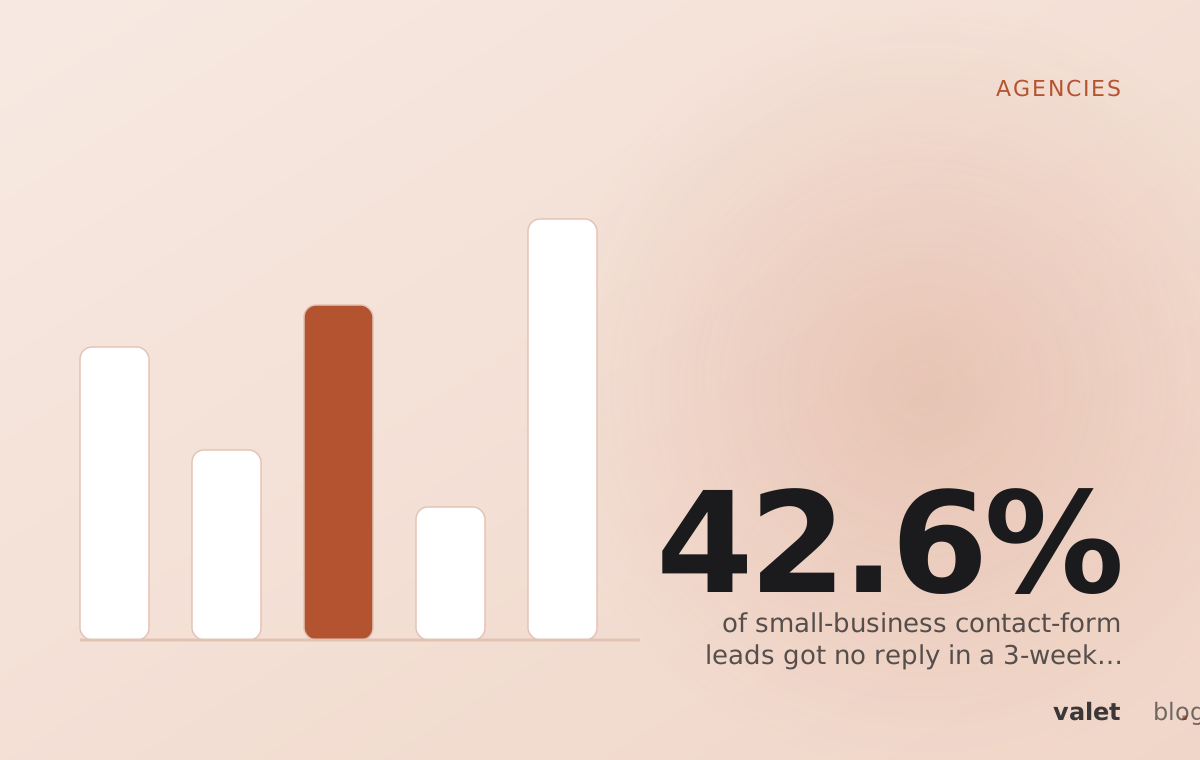
| Leadferno, June 202412 | 225 small-business contact forms, home, professional and medical services | 42.6% no reply in 3 weeks; mean first human reply 17 h 49 m |
| Pied Piper PSI, April 20261 | 3,211 home-services locations, phone, chat and web form | 72% no follow-up in 24 h; 28% offered an appointment |
| WeddingPro "Hello to Hired" (undated)13 | Couples on The Knot and WeddingWire | Couples contact 5 vendors per category; reply in under 3 h, couples 2.2x more likely to reply |
The second shift is under way now: the first reply is being commoditised. Perfect Venue's First Reply sends an automated, personalised answer to contact-form inquiries, and its help page draws the boundary itself: "First Reply handles the first touchpoint; everything after that is you."8 Google is piloting an AI agent inside Business Profile messages that sorts conversations into "Handled by your AI agent" and "Needs your attention"; the pilot is US-only and undocumented9. WeddingPro announced AI tools "for faster vendor responses" in the same April 2025 post3.
This is a familiar pattern, the commoditisation of the complement. When the first reply becomes free, its value moves to the next step: the follow-up, the held tour time, the deposit. Every tool above stops before that step.
The bottlenecks: owner time, timing, and the agency contract#
Three structural bottlenecks keep venue handling slow, and none of them is solved by better ads.
The owner is the choke point. MMCG counts 35,829 US venues, 71.8% of them single-owner11. Price exceptions, date holds and deposits need that owner. Indigo Digital proposes a "Human handover: same day, with full conversation context attached"6, which assumes someone is free that day.
Inquiries arrive off-hours. Indigo notes that "A large share of wedding and event enquiries arrive in the evening, on weekends, and during public holidays," and warns that a lead without an immediate response "can become functionally unreachable. They rarely say no, they simply stop replying."6
Agency contracts measure the wrong hop. Most agency reports count leads delivered. Indigo says median first response time is "the metric most directly correlated with site visit rate, and the one most venues have never measured"5. If the venue does not measure it and the agency cannot see it, nobody owns it.
The unit economics, as an illustration#
Illustration Take a venue receiving 40 inquiries a month. Assume, as in Pied Piper's home-services sample, that 72% get no follow-up1. That is about 29 inquiries a month, or 346 a year. If just 10% of those would have booked with a follow-up, that is about 35 weddings. At The Knot's 2026 average venue spend of $12,90010, the bookings at risk come to roughly $446,000 a year. Set that against a hypothetical agency retainer of $2,000 to $4,000 a month and the agency's results depend on a layer its contract does not cover. Every input here is an assumption except the two sourced figures, and Pied Piper did not survey venues.
Three scenarios to April 2028#
The three scenarios below differ in who ends up owning the step after the first reply. They are not ranked by likelihood, and no probabilities are attached because no venue-level data exists to calibrate them.
Base case: first reply automated, follow-up still manual#
In the base case, first-reply tools spread through platforms and venue software, and median first response falls. Follow-up stays manual, because the tools stop at the first touch. If that holds, inquiry-to-tour rates improve a little, then plateau. Agencies keep reporting volume, and the "fake lead" complaint persists, because quiet leads still look fake.
Acceleration: agencies report handling, and sell it#
In the acceleration case, agencies add handling metrics to monthly reports: median first response, share offered a tour time, follow-ups sent. Indigo already argues for reporting "the four numbers between an impression and a signed contract"5. If that becomes standard, renewals start to depend on booked share, and agencies bundle follow-through into the retainer. The constraint is inbox access; it moves only if venues adopt tools that log handling without exposing the whole inbox.
Structural stall: the quality fight absorbs the attention#
In the stall case, the lead-quality dispute dominates. Venues cut directories, agencies argue about attribution, and nobody measures handling. If that holds, lead volume falls along with spend, but booked share does not rise, because the leak was never in the channel. The tell would be a second wave of complaints with no change in vendor reply behaviour.
Leading indicators to watch over the next 18 months#
Leading indicators move before the booking line does; the booking line itself is a lagging indicator. The matrix below separates them and gives each a threshold that should trigger action. It works as a monthly agenda for an agency and venue review.
| Indicator | Type | Where to read it | Act when |
|---|---|---|---|
| Median time to first response | Leading | Inbox or venue software timestamps | Over 3 h (WeddingPro's reply threshold) |
| Share of answered inquiries offered a specific tour time | Leading | Sent replies, sampled monthly | Under half of answered inquiries (desk default) |
| Follow-ups sent after an inquiry goes quiet | Leading | Sent replies | Zero on most quiet inquiries |
| Inquiry-to-tour rate | Leading | Calendar vs inquiry count | Under 30% (Indigo's warning threshold) |
| Off-hours inquiry share | Context | Inquiry timestamps | Rising while response staffing is flat |
| Qualified inquiry-to-booking rate | Lagging | Contracts signed vs qualified inquiries | Well below 1 in 5 (Indigo's benchmark) |
| Agency retainer renewal | Lagging | Contract dates | Renewal talk before handling was measured |
Thresholds: WeddingPro "Hello to Hired" (3 h); Indigo Digital 2026 (30% to tour, 1 in 5 to booking); the tour-time threshold is the Trends desk's working default, not a published benchmark.
Indigo's 1-in-5 booking benchmark means a venue booking 60 weddings a year needs about 300 qualified inquiries7. Handling indicators show whether those 300 had a fair chance.
What this means for agency owners and venue owners#
For agency owners, the practical move is to measure the hop you are blamed for. Run an agency-branded Lost Lead Audit on a venue client's last 90 days, using the method in the Lost Lead Audit, and put handling numbers beside volume in the next report. For venue owners, the move is to track median first response and tour times offered, as set out in what a good inquiry-to-booking rate is. For the follow-up itself, see how many times to follow up with a couple.
When this forecast expires#
This forecast expires on 1 April 2027. Revise it earlier if any of these happen: Google documents or widens its Business Profile AI agent; a wedding-specific mystery shop publishes no-reply and follow-up rates; Tripleseat's next report quantifies response time against conversion; or venue audit data reaches a sample large enough to publish. Valet could publish venue first-reply and follow-up rates from Lost Lead Audits once enough exist; none are published here.
Where Valet fits#
Valet is a small business's own AI assistant for written inquiries, and venues are a natural fit. The venue forwards an address such as events@ to Valet. It answers from the venue's own packages, minimums and calendar, offers and holds real tour times, and sends at most two useful follow-ups by default before telling the owner why it stopped. Deposits, contracts, discounts and complaints go to the owner. Each reply has a Valet receipt, which an agency can use as the handling record it never had.
Start with the free lead check: forward 10 to 20 recent inquiries, or show them on a call, and see what went unanswered, what stopped after one reply, and what it was worth.
Questions people ask
Why are my wedding venue marketing leads not converting?
Check handling before channels. Measure median time to first response, the share of answered inquiries that were offered a specific tour time, and how many got a follow-up after going quiet. Indigo Digital calls median first response the metric most venues have never measured.
How fast should a wedding venue respond to an inquiry?
Tripleseat's 2026 report sets a goal of responding to every lead within 30 minutes, and Indigo Digital proposes a first response within 60 seconds. WeddingPro reports that replying in under 3 hours makes couples 2.2 times more likely to reply.
Why don't wedding vendors respond to inquiries?
Most venues are small: MMCG counts 71.8% of US venues as single-owner. Inquiries arrive in evenings and on weekends, and price, date holds and deposits need the owner, so replies wait for the owner's next free hour.
What should a wedding marketing agency report to a venue client?
Lead volume plus handling: inquiries received, median first response, share offered a tour time, follow-ups sent, tours held and bookings. Handling numbers explain why the same lead volume books differently month to month.
Sources
Confidence: H primary source checked · M credible secondary or reported · L vendor claim or single report. Reddit and forum items are quoted from public threads and summarised, not endorsed.
- Precision Garage Door Ranked #1 in Customer Lead Handling Effectiveness Home Services Study · Pied Piper Management Company via BusinessWire · 2026-04-12 H
- The 2026 Event Intelligence Report: data, benchmarks and blueprints for high-growth venues · Tripleseat · 2026 M
- Taking action on feedback · WeddingPro (The Knot Worldwide) · 2025-04-02 H
- Grassley presses FTC to investigate alleged fraud, deceptive business practices at wedding website The Knot · Office of Sen. Chuck Grassley · 2025-10-22 H
- Five venue funnel metrics worth reporting on · Indigo Digital · 2026-05-12 M
- The response time benchmark every venue is failing · Indigo Digital · 2026-07-14 M
- Wedding venue lead benchmarks guide · Indigo Digital · 2026-08-03 M
- First Reply: automated responses to new inquiries · Perfect Venue help center · 2026 H
- Google reintroduces Business Profile messaging with an AI agent · Partoo · 2026-07-16 (updated 2026-09-09) M
- Average wedding vendor costs (Real Weddings Study 2026, n=10,474) · The Knot · 2026-09-29 H
- The U.S. wedding venue market: an investment thesis for 2026–2030 · MMCG Invest · 2026-03-21 (updated 2026-08-14) M
- Research: website contact forms and lead management, uncovering costly mistakes · Leadferno · 2024-06-28 H
- From Hello to Hired: your guide to lead replies · WeddingPro · undated H
- "Rant: vendors not responding" (thread, 30+ comments; Google snippet) · Reddit, r/weddingplanning · c. 2022 M
- Love a venue but can't get a response · WeddingWire forums · 2024-05-21 H
How to cite this page
Cite this page
Valet, "Wedding and event marketing agencies: the leads you generate die in the venue's inbox", valet.team, October 2026.
Keep reading
 Agencies"My client doesn't reply to the leads we send": the agency's lead follow-through problemYour campaign delivers the lead. Then it lands in an inbox you don't control. Here is where those leads go, what it costs the client, and how an agency can prove it without taking over anyone's email.Explainers · 8 min · 1 October 2026
 AgenciesContact form "works" but leads disappear: the enquiry-system test for web designersThe form submits, the plugin says sent, and the client still says nobody ever got in touch. This is a forensic walk down the path from submit button to booked customer, with a 10-point test you can run on every site you hand over.Technical desk · 8 min · 1 October 2026
 AgenciesHow to prove your website generates leads when the client never replies to themA monthly lead-handling report separates the leads your site delivered from the leads your client answered. Here is the runbook, the template, and what to do when the client pushes back.Playbooks · 8 min · 1 October 2026