
Startups & support@
"Intercom is too expensive for a startup": the cost-creep arithmetic (seats, outcomes, add-ons) and the four ways out
The bill that surprises founders is not one price. It is seats, add-ons and per-outcome fees stacking up just as a startup discount ends. Here is the arithmetic, what each alternative charges when the bot gets stuck, and the signals to watch.
Short answer
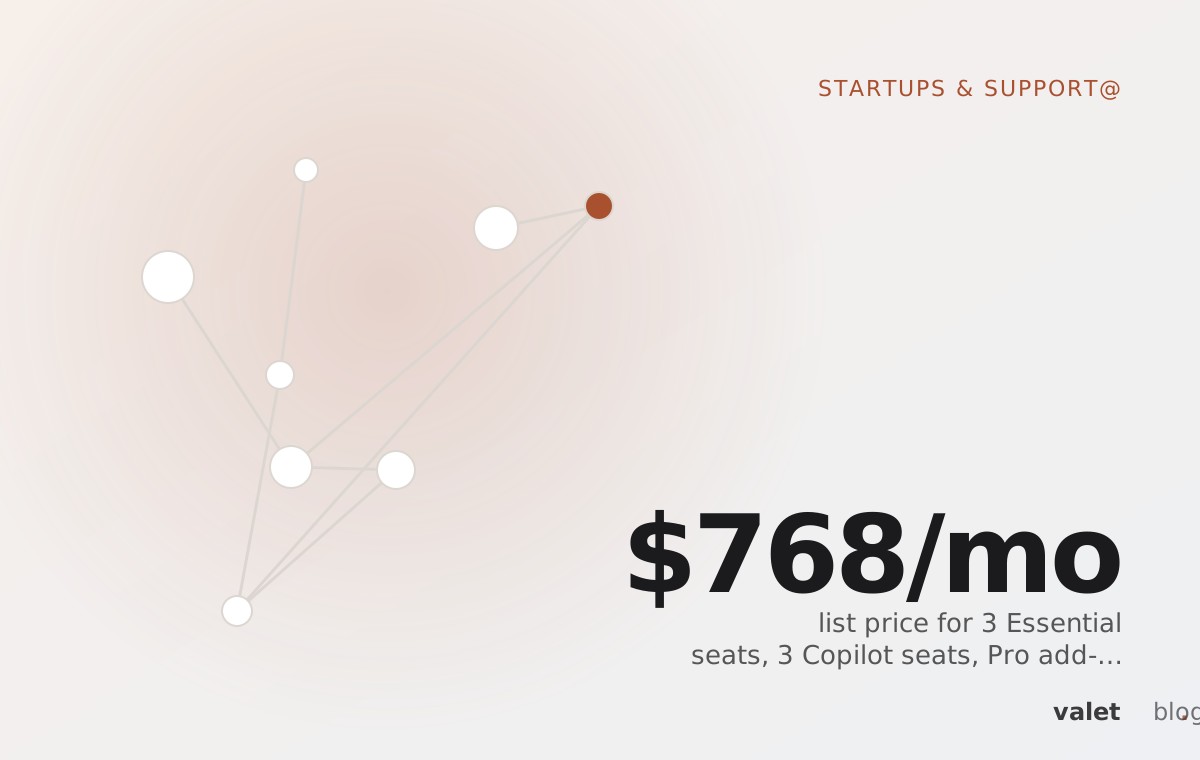
Intercom gets expensive for startups because three charges stack: seats, add-ons and per-outcome AI fees. At list prices on 1 October 2026, three Essential seats ($87), Copilot for three ($87), the Pro add-on (from $99) and 500 Fin outcomes at $0.99 ($495) come to about $768 a month, or $9,200 a year. The Early Stage discount hides most of this in year one. The four exits are flat (Crisp), capped (Help Scout), credits (Plain) or build your own.
$768/mo
list price for 3 Essential seats, 3 Copilot seats, Pro add-on and 500 Fin outcomes
Valet arithmetic from intercom.com and fin.ai list prices, 1 Oct 2026
$0.99
per Fin outcome, 50-outcome monthly minimum; a configured hand-off is also billed
fin.ai/pricing, 1 Oct 2026
93%
off Intercom for qualifying startups, plus a year of Fin, under the Early Stage Program
intercom.com and fin.ai, 1 Oct 2026
Intercom gets expensive for a startup because three charges stack and grow at different speeds: seats, add-ons and per-outcome AI fees. At list prices on 1 October 2026, three Essential seats ($87), Copilot for three agents ($87), the Pro add-on (from $99) and 500 Fin outcomes at $0.99 ($495) add up to about $768 a month, or roughly $9,200 a year12. In year one, the Early Stage Program covers much of that. The four common exits are a flat price (Crisp), a capped AI fee (Help Scout), bundled credits (Plain) or your own build. A fifth option avoids the helpdesk entirely.
Why "Intercom is too expensive" is the wrong diagnosis#
The complaint founders post is about price, and the underlying problem is shape. One r/intercom thread (9 comments, mid-2026) calls the product "frustratingly inelastic". A post in r/SaaS from a founder who "built my own" (spring 2026) puts the timing precisely: "the bill scales up right when you're most fragile as a company". In r/customerexperience (30+ comments), the top answer to a question about AI agent spend reads: "we just got rid of Fin. Cost way too much and didn't even work the way we needed".
Read together, these describe a cost curve with a cliff, not a high sticker price. Seats rise with headcount. Outcomes rise with customer count. Add-ons rise with features you switched on during a trial. And the discount that made all three tolerable ends on a fixed date, regardless of revenue. A G2 reviewer in August 2026 described "many features requiring additional payment, leading to unexpected bills"; another in June 2026 wrote that "The cost may be harder to justify for smaller teams with lower support volume"8.
The year-two bill: how much does Intercom cost a 3-person startup?#
The year-two bill is the monthly cost at list price once the startup discount ends. Intercom's page lists Essential seats at $29 per seat per month, Copilot at $29 per agent per month (with 10 free Copilot conversations per agent per month), and the Pro add-on "From $99/mo"1. Fin's page lists "$0.99 per outcome" with "50 outcomes per month minimum"2. An earlier read of Intercom's page recorded Copilot at $35 per user; billing period may explain the difference, so use the figure on your own quote.
| Line | Formula | 200 outcomes | 500 outcomes | 1,000 outcomes |
|---|---|---|---|---|
| Essential seats | agents × $29 | $87 | $87 | $87 |
| Copilot | agents × $29 | $87 | $87 | $87 |
| Pro add-on | from $99 | $99 | $99 | $99 |
| Fin outcomes | outcomes × $0.99 (min 50) | $198 | $495 | $990 |
| Monthly | sum | $471 | $768 | $1,263 |
| Annual | monthly × 12 | $5,652 | $9,216 | $15,156 |
Your inputs:
Agents (seats):                 ___
Add-ons switched on:            Copilot ___  Pro ___  other ___
Fin outcomes last month:        ___   (growth per month: ___%)
Of which "no further help
requested" (not confirmed):     ___
Configured hand-offs billed:    ___
Discount end date:              ___
Renewal price quoted:           ___
Month the bill passes $___:     ___
Valet arithmetic from list prices on intercom.com and fin.ai, read 1 October 2026. Excludes tax, other add-ons and any negotiated discount.
The outcome line is the one that moves. A Hacker News commenter who built support in-house put it this way in June 2026: "tickets that take a human 1 min to respond to now cost you $0.99 ($60+/hour)"7. And the Early Stage offer, "Get a year of Fin + 93% off Intercom"2, means the first year rarely shows any of this. We have not seen the program's full terms. Check your agreement for the end date and the renewal price.
What does each option charge when the bot gets stuck?#
The fairest way to compare support tools for a small team is on what you pay when the AI cannot answer, because that is where definitions differ most. All figures below are as read on vendor pages on 1 October 2026.
| Option | Base price | AI unit | When the bot is stuck |
|---|---|---|---|
| Intercom + Fin | $29–132 per seat/mo; add-ons extra1 | $0.99 per outcome, 50/mo minimum2 | A configured "Procedure handoff" is a billed outcome; a resolution is billed when "No further help is requested after Fin's last answer"2 |
| Crisp | Flat per workspace: $45 (4 seats), $95 (10 seats), $295 (20+)3 | AI credits: $5, $25, $75 included ("around" 90, 450, 1,350 automated conversations)3 | Not defined on the pricing page; extra AI usage price not listed |
| Help Scout | $25, $45 or $75 per user/mo; free plan for 5 users4 | $0.75 per AI resolution; 3-month free trial4 | Not charged if the customer escalates or clicks "I still need help"; a monthly spending cap disables AI Answers when reached4 |
| Plain | Foundation $35/mo per seat; Horizon $299/mo for 3 seats (as read 1 Oct 2026)5 | AI credits included on every plan5 | Credits per AI resolution not stated on the pricing page |
| Zendesk Suite Team | $55 per agent/mo, annual6 | 5 automated resolutions per agent included; then $1.50 committed or $2.00 pay-as-you-go6 | Billed only for requests "successfully resolved by the AI agent, without any escalation to a human agent"6 |
| Build your own | Your time | Model tokens | Tokens are spent either way; the hand-off path is whatever you build |
Vendor pages as cited. Plain's page showed different per-seat figures in two reads on the same day ($45 and $35); confirm on the day you buy. Startup programs: Plain advertises 50% off5; Help Scout has an early-stage program4.
At 500 AI resolutions a month for three users, Help Scout Standard lists at $75 in seats plus $375 in resolutions, or $450, before any cap you set4. Zendesk Suite Team for three agents lists at $165 plus 485 resolutions beyond the 15 included, or about $893 to $1,1356. Neither figure is a recommendation. They show that per-resolution pricing at this volume is not cheap anywhere; the definition and the cap decide how fast it grows.
The four ways out, and the fifth#
The four exits founders name in threads each trade one risk for another. A top answer in an r/SaaS thread on alternatives (20+ comments, mid-2026) suggests "Crisp, Help Scout, or Zendesk", which matches the table above.
- Flat: Crisp. Predictable workspace pricing, so headcount growth costs nothing until the seat cap. The trade: included AI credits are small, and the page does not say what extra AI usage costs.
- Capped: Help Scout. The narrowest billing definition in the set, plus a monthly cap. The trade: when you hit the cap, AI Answers switches off for the rest of the month, so plan what customers see then.
- Credits: Plain. AI bundled into seats rather than metered per outcome. The trade: the pricing page does not say how many credits a resolution uses, so model it from the credits help article before you sign.
- Build your own. One Hacker News commenter reported "$100 in tokens to build" and "an hour of maintenance work per week"; another said the hard parts are tools, log review and "tuning human escalation procedures", which took "months of work"7. The trade: you own the escalation path and the liability.
- Do not migrate. Keep support@ where it is, forward it to an assistant that answers from your written facts and hands off the rest, and pay a base fee rather than a per-seat helpdesk. This option suits teams whose support is mostly email and whose answers fit on a page.
Whichever exit you choose, the risk that survives is the definition of success. Intercom itself declined to bill its sales agent on closed revenue, writing in May 2026 that it "breaks down" on attribution and measurement, and priced per qualified lead instead10. For the definitions in full, see what counts as an AI resolution.
Where is startup support pricing heading? Three scenarios to October 2027#
Startup support pricing over the next year depends on whether per-outcome prices fall faster than outcome volumes rise. The weights below are editorial judgement, not data.
| Scenario | What happens | Weight (judgement) | Signal that it is happening |
|---|---|---|---|
| Base case: drift | Per-outcome list prices stay near $0.75–2.00; seats and add-ons keep rising slowly; startup programs continue | About 50% | No change on fin.ai, helpscout.com and zendesk.com pricing pages by April 2027 |
| Price compression | Outcome prices fall as vendors compete; HubSpot already moved from $1.00 per conversation to $0.50 per resolved conversation in April 20269 | About 30% | A second major vendor cuts its per-outcome price by a third or more |
| Structural stall | Consolidation bundles AI support into larger suites with higher minimums; small teams are priced toward annual contracts | About 20% | Minimum outcome commitments rise, or startup discounts shrink after acquisitions; a June 2026 Hacker News thread discussed a reported Salesforce deal for Fin7 |
Leading indicators to watch in your own bill#
The leading indicators for a support bill are in your own invoice and admin panel, and they move months before the total does.
- Outcomes per 100 conversations. If it rises while customer satisfaction does not, you may be paying for customers who stopped asking.
- Billed hand-offs. Count configured hand-offs billed as outcomes on Fin. Each is a $0.99 charge for a conversation a person still has to answer.
- Seats added for Copilot or inbox access only. Seats bought for one feature are the quietest form of creep.
- Discount end date. Put it in the calendar three months ahead, with the renewal quote.
Forecast expiry. Revisit this page by 1 April 2027, or earlier if any vendor in the table changes its AI unit or its definition. Prices here are dated 1 October 2026 and will go stale.
Where Valet fits#
Valet is the "do not migrate" option. You forward support@ to a private Valet address; replies go out from support@ once the domain is verified, and there is nothing to migrate. Valet answers only from your own facts, never invents a price, discount or policy, and sends money, complaints and contracts to you with one-tap replies while telling the customer when you will reply. Every reply says it is AI and comes with a Valet receipt. Early-access pricing is a small monthly base plus a fee only for bookings or quotes Valet wins, capped monthly, month to month. To see what your support@ holds today, start with the free lead check: forward 10 to 20 recent emails and see what went unanswered.
Questions people ask
Why is Intercom so expensive for startups?
Because the bill has three layers that grow separately: per-seat helpdesk fees, add-ons such as Copilot and the Pro add-on, and $0.99 for each Fin outcome. The Early Stage Program discounts much of this in year one, so the full bill often arrives in year two.
How much does Intercom Fin cost per month for a small team?
At list prices on 1 October 2026, three Essential seats, three Copilot seats, the Pro add-on and 500 Fin outcomes total about $768 a month. Fin alone has a 50-outcome monthly minimum, which is $49.50 before seats.
What is a cheaper alternative to Intercom for a small team?
Crisp charges a flat monthly price per workspace with small AI credits included. Help Scout charges per user plus $0.75 per AI resolution with a monthly cap. Plain bundles AI credits into per-seat plans. Building your own costs tokens and engineering time. Compare them on what you pay when the bot cannot answer.
Does Intercom charge when Fin hands off to a human?
Fin's pricing page lists a 'Procedure handoff', where Fin completes a Procedure you configured to hand off to a human, as a billable outcome at $0.99. A resolution is billed when no further help is requested after Fin's last answer.
When does the Intercom startup discount end?
Fin's page offers a year of Fin plus 93% off Intercom through the Early Stage Program. Check your own agreement for the end date and the renewal price, and put the date in your calendar three months ahead.
Sources
Confidence: H primary source checked · M credible secondary or reported · L vendor claim or single report. Reddit and forum items are quoted from public threads and summarised, not endorsed.
- Intercom pricing · Intercom · 2026-10-01 H
- Fin pricing · Fin (formerly Intercom) · 2026-10-01 H
- Crisp pricing · Crisp · 2026-10-01 H
- Help Scout pricing · Help Scout · 2026-10-01 H
- Plain pricing · Plain · 2026-10-01 H
- Zendesk pricing · Zendesk · 2026-10-01 H
- Hacker News discussion thread, item 48540126 (Salesforce and Fin) · Hacker News · 2026-06 H
- Intercom reviews (cons) · G2 · 2026-08 H
- HubSpot Breeze pricing change · Resolve247 · 2026-04 M
- Building outcome-based pricing for Fin for Sales · Intercom · 2026-05-08 H
How to cite this page
Cite this page
Valet, "Intercom is too expensive for a startup: the cost-creep arithmetic (seats, outcomes, add-ons) and the four ways out", valet.team, October 2026.
Keep reading
 Startups & support@Should a startup use AI for customer support? What founders who lost customers say, and the three missing controlsCustomers accept AI support when they can reach a person. The failures that cost startups customers trace to three missing controls, not to the model.Data desk · 11 min · 1 October 2026
 Startups & support@How to handle support@ as a solo or 3-person SaaS founder (without hiring, and without a bot that traps people)Sort support@ into four categories, give each a written promise and an automation level, and check the handoffs every week. Here is the runbook, plus the six ways it breaks.Playbooks · 12 min · 1 October 2026
 Startups & support@An AI agent that answers vs one that finishes the job: what "acts" means for a small business, and the four controls that make it safeMost AI tools sold to small businesses answer the first message and stop. This piece defines what it means for an agent to finish the job, traces where answer-only tools lose the inquiry, and sets out the four controls that make acting safe.Technical desk · 11 min · 1 October 2026