
Startups & support@
Plain vs Pylon vs Help Scout vs Crisp vs Chatwoot vs Fernand vs Front for a 5-person startup: what each charges for AI, and what happens when the bot is stuck
Seven support tools, priced from their own pages on 1 October 2026 for a five-person team. Seat prices are easy to compare. The AI unit, what counts as one, and what happens when the bot cannot answer are not, and only two pages define them.
Short answer
For five people, list prices on 1 October 2026 run from $0 (Fernand's free tier, capped at 100 sent messages a month) to $225 a month (Plain Foundation, billed annually). Help Scout is $125 plus $0.75 per AI resolution, Crisp $95 flat with $25 of AI credits, Chatwoot $95 plus credits, Front $125 with AI via sales, and Pylon is demo-only. Only Help Scout's page says what happens to billing when a customer asks for a human: it does not charge.
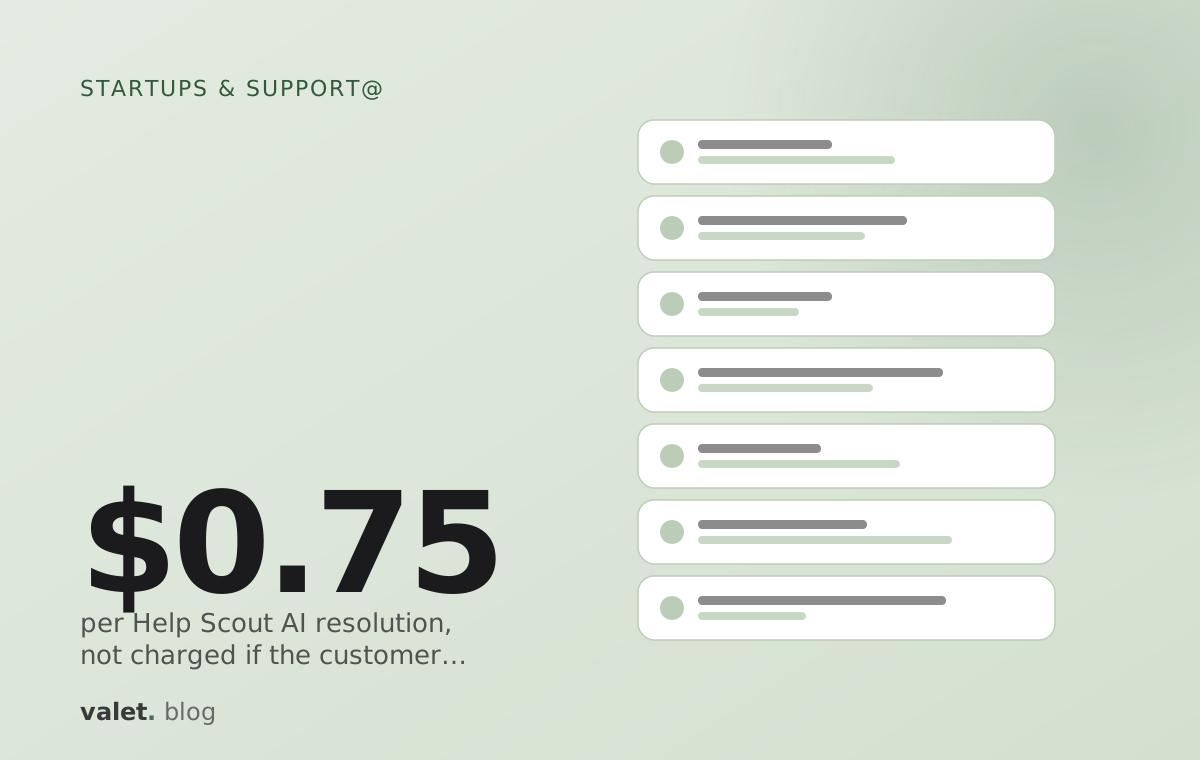
$0.75
per Help Scout AI resolution, not charged if the customer escalates or clicks "I still need help"
helpscout.com/pricing, 1 Oct 2026
100 credits
per Ari resolution on Plain, against 1,000 monthly credits on the annual Foundation plan
plain.com/pricing, 1 Oct 2026
$95
a month flat for Crisp Essentials (10 seats) with $25 of AI credits included
crisp.chat/en/pricing, 1 Oct 2026
For a five-person startup, the seven tools in this comparison list prices from $0 to $225 a month on 1 October 2026, before AI usage. Fernand's free tier costs nothing but caps sent messages at 100 a month6. Plain Foundation costs $225 a month on annual billing1. Help Scout is $125 plus $0.75 per AI resolution3, Crisp $95 flat4, Chatwoot $95 plus credits5, Front $125 with its AI agent sold through sales7, and Pylon publishes no price2. The seat price is the easy part. The AI unit, its definition, and the bot's behaviour when stuck decide the real bill, and only Help Scout's pricing page addresses all three3.
What does this comparison cover, and what does it not?#
The comparison on this page covers the public pricing pages of seven support tools, read on 1 October 2026, applied to a team of five people. It does not cover features outside pricing, sales-negotiated discounts, or product quality, which we did not test. Where a page is silent on a point, the table says "not stated on the pricing page" rather than inferring an answer.
The tool set reflects what founders name in public. A thread in r/SaaS (20+ comments, mid-2026) asking for an option other than Intercom drew a top answer of "You could look at Crisp, Help Scout, or Zendesk they tend to get good feedback from startups." A solo founder in another r/SaaS thread (late 2025) replied, "thanks I will try Crisp." Fin appears as a reference row because it sells its AI agent to work with any helpdesk8. Zendesk and Intercom's own helpdesk are covered in what counts as an AI resolution.
Which plans fit five people?#
Seat caps decide which plan a five-person team may buy before price enters the analysis. Several entry plans stop just below or at five, which pushes a team of five onto a higher tier.
- Plain Foundation allows "Up to 5" seats, so five people fit exactly; a sixth requires Horizon at $99 per user, minimum three seats1.
- Crisp Mini covers 4 seats at $45, so five people need Essentials at $95, which covers 104.
- Chatwoot Hacker is free for 2 agents and 500 conversations a month; five agents need a paid plan from $19 per agent5.
- Help Scout Free covers 5 users, 1 inbox and 100 contacts a month; paid plans start at $25 per user3.
- Front Starter runs up to 10 seats at $25 per seat7.
- Fernand Free lists unlimited seats, with a cap on outbound messages6.
- Pylon lists no plans; its pricing address leads to "Schedule a personalized 30-minute demo"2.
The five-person AI pricing table (checked 1 October 2026)#
The comparison table below records, for each tool, the published price for five people, the unit in which AI is charged, the page's own definition of that unit, what the page says happens when the bot cannot help, and any startup offer. Quoted text is verbatim from the vendor's page.
| Tool | 5 people, per month | AI unit | What counts (page wording) | When the bot is stuck (page wording) | Startup offer |
|---|---|---|---|---|---|
| Plain (Foundation) | $225 annual ($45/user); $275 monthly ($55/user) | Credits: "Ari (customer AI agent) 100 credits/resolution"; 1,000 credits/month annual, 500 monthly | Not stated on the pricing page | Not stated on the pricing page | "startup program for 50% off" |
| Pylon | No public price | Not published | Not published | Not published | Not published |
| Help Scout (Standard) | $125 ($25/user, annual) | "AI Answers Add-on $0.75 /resolution"; monthly spending cap | "only if the customer receives an AI response and doesn't use escalation, search the knowledge base, ask more questions, or indicate that they need more help" | Customer can escalate or click "I still need help"; "you won't be charged" | "3-month free trial" |
| Crisp (Essentials) | $95 flat (10 seats) | Dollar AI credits; "$25 included AI credits" | Not stated on the pricing page | Not stated on the pricing page | Not stated |
| Chatwoot (Startups) | $95 ($19/agent) | Captain credits (300 listed on Startups); "$20 / 1,000 credits" | Not stated on the pricing page | Not stated on the pricing page | Free Hacker plan (2 agents); self-hosted option |
| Fernand (Free) | $0, unlimited seats | "Send 100 messages per month"; "Train your AI, up to 50 MB" | Not stated on the pricing page | Not stated on the pricing page | Free tier; "'Sent via Fernand' on email" |
| Front (Starter) | $125 ($25/seat, annual) | Autopilot "Starting at $0.05 /conversation", via sales; Copilot "$20 / seat / month" | Not stated on the pricing page | Not stated on the pricing page | Not stated |
| Fin (reference) | From $49.50 (50-outcome minimum) plus a helpdesk; Intercom seats from $29 | "$0.99 PER OUTCOME · 50 OUTCOMES PER MONTH MINIMUM" | "Resolution: No further help is requested after Fin's last answer" | "Procedure handoff: Fin completes a Procedure you've configured" counts as a billable outcome | Early Stage Program: "an entire year of Fin completely free… 93% off Intercom" |
Sources: vendor pricing pages, 1 Oct 2026123456789. Prices change; re-check before you sign. "Not stated" means the pricing page did not say; the vendor's help docs or contract may.
Which pricing pages say what an AI unit is, and which leave it open?#
Two of the eight pricing pages in this comparison define the AI unit in words a buyer can test: Help Scout and Fin. The other six either meter AI in credits without saying what one reply consumes, or route AI pricing to sales, or publish nothing.
The distinction matters as a materiality threshold. A defined unit lets a founder estimate next month's bill from a count of conversations. An undefined credit does not. Plain is the clearest case. Its search ads, seen on 1 October 2026, read "Transparent pricing with AI included, never per resolution." Its pricing page then lists "Ari (customer AI agent) 100 credits/resolution," against 1,000 credits a month on the annual Foundation plan1. The ad is accurate in form, since no dollar price attaches to a resolution. In effect, the plan includes about ten Ari resolutions a month before more credits are needed.
Crisp and Chatwoot are predictable on the seat side and open on the AI side. Crisp includes "$25 included AI credits" on Essentials4; Chatwoot sells "$20 / 1,000 credits"5. Neither pricing page, as read, states how many credits one answered conversation uses. Front's Autopilot is "Starting at $0.05 /conversation" through sales7. "Starting at" is a floor, not a price.
What must, should and may a buyer check before signing?#
A buyer's obligations here are contractual, not statutory, but the same discipline applies: separate what the vendor commits to in writing from what its marketing implies. The checklist below uses "must" for points that change the bill or the customer's experience, "should" for points that change risk, and "may" for points worth asking if time allows.
- Must obtain the definition of the billed AI unit in writing, including whether a customer who stops replying counts.
- Must confirm whether billing stops when the customer asks for a human. Help Scout says it does3; under Fin, a configured handoff procedure is itself a billable outcome8.
- Must confirm what the customer sees when the bot is stuck: a route to a person, and a stated time for the reply.
- Should ask for a monthly spending cap. Help Scout offers one on its page3.
- Should ask for conversation-level records of every billed unit, so the invoice can be checked line by line.
- Should note when any startup discount ends and price the second year at list.
- May ask whether unused credits roll over, and whether credits are pooled across seats.
- May ask how the vendor's terms allocate responsibility for AI output.
On that last point, a commenter in a June 2026 Hacker News thread quoted Intercom's AI terms as saying the "Customer is responsible for its use of the AI Product(s) and Output" and that Intercom "provides no indemnities with respect to Output"10. We have not read the terms page directly, and other vendors' terms were not reviewed. Not legal advice; check with counsel.
What happens when the bot is stuck, and why does the pricing page matter?#
A stuck bot is the point at which pricing and customer experience meet, because the billing rule decides whether the vendor is paid for the conversation that failed. Under a "no further help requested" rule, a customer who gives up looks like a success. Under Help Scout's rule, a customer who clicks "I still need help" is not billed3. Neither rule, by itself, ensures a person replies.
The reply is where the evidence is weakest. In Gorgias platform data from accounts with 200+ AI-touched tickets (October 2025 to April 2026), 55% of AI-touched tickets went to a human, and about a third of those never got a human reply11. That cohort is e-commerce, not B2B SaaS. The pattern still warrants a redline in any contract: the vendor's obligation ends at the handoff, and the reply-by time is the buyer's to keep. For what a handoff should include, see what "never stuck with a bot" has to mean.
What does each tool cost at 100 and 300 AI-handled conversations a month?#
Monthly cost at volume can be computed from the pricing page alone for only two of the eight rows. For the others, the result depends on a credit rate or a sales quote the pages do not give.
| Tool | 100 a month | 300 a month | Why |
|---|---|---|---|
| Help Scout Standard + AI Answers | Up to $200 | Up to $350 | $125 + $0.75 per resolution; escalated conversations not billed |
| Fin (outcomes only) | $99 | $297 | $0.99 per outcome, 50 minimum; helpdesk extra |
| Plain Foundation (annual) | $225 + credits beyond ~10 resolutions | $225 + credits beyond ~10 resolutions | Extra credit price not stated on the page as read |
| Crisp Essentials | $95 + credits beyond $25 | $95 + credits beyond $25 | Credits per conversation not stated |
| Chatwoot Startups | $95 + credits | $95 + credits | $20 per 1,000 credits; credits per conversation not stated |
| Front Starter + Autopilot | $125 + from $5 | $125 + from $15 | "Starting at $0.05 /conversation"; sales quote needed |
| Fernand Free | $0 | Over the cap | 100 sent messages a month on the free tier |
| Pylon | Quote | Quote | Demo-gated |
Arithmetic by Valet from list prices1345678. "Up to" because Help Scout does not bill escalated conversations.
Open questions the pages leave unresolved#
Three ambiguities remain after reading all eight pricing pages. First, Pylon's price for a five-person team is unknown without a demo2. Second, for the credit-metered tools, the cost of one AI-answered conversation cannot be derived from the page, so the comparison between Plain, Crisp and Chatwoot on AI cost stays open. Third, no page in the set states what the customer is told when the bot hands off, or whether a reply time is promised. Those answers sit in help docs and contracts, which this comparison did not review.
Every tool in this table is also a helpdesk to move into, with its own inbox, seats and widget. For a five-person team that already answers from support@, the migration is a cost the pricing page does not show. Our support@ runbook for small SaaS teams covers what to set up whichever tool you choose.
Where Valet fits#
Valet is not a helpdesk, so it does not appear as a row. You forward support@ to a private Valet address and keep your inbox; replies go out from your own address once the domain is verified, and there is nothing to migrate. Valet answers only from your own facts and never invents a price, discount or policy. When it cannot answer, the topic goes to you with one-tap replies and the customer is told when you will reply. Every reply has a Valet receipt with the rule and sources used. Pricing during early access is a small monthly base plus a fee only for bookings or quotes Valet wins, capped monthly, month to month. To see what your inbox holds first, use the free lead check: forward 10 to 20 recent emails.
Questions people ask
Plain vs Pylon: which is cheaper for a small startup?
Plain publishes its price: Foundation is $45 per user a month billed annually, up to five seats, with 1,000 AI credits a month. Pylon publishes no price; its pricing page leads to a demo booking. You cannot compare them without a quote from Pylon.
Help Scout vs Crisp for a startup: which charges less for AI?
For five people, Help Scout Standard is $125 a month plus $0.75 per AI resolution, and Crisp Essentials is $95 a month flat with $25 of AI credits included. Help Scout defines what it bills; Crisp's pricing page does not say what one AI credit buys.
What happens when a helpdesk AI bot can't answer?
Most pricing pages do not say. Help Scout states it does not charge when the customer escalates or clicks "I still need help". Fin counts a configured handoff as a billable outcome. For the rest, ask the vendor in writing before you buy.
Do support tools offer startup discounts?
Some do. Plain lists a startup program for 50% off, Fin's Early Stage Program offers a year of Fin free and 93% off Intercom, and Help Scout lists a 3-month free trial. Check when each ends and what the bill is after.
Sources
Confidence: H primary source checked · M credible secondary or reported · L vendor claim or single report. Reddit and forum items are quoted from public threads and summarised, not endorsed.
- Plain pricing · Plain · 2026-10-01 H
- Schedule a demo (pricing redirect) · Pylon · 2026-10-01 H
- Help Scout pricing · Help Scout · 2026-10-01 H
- Crisp pricing · Crisp · 2026-10-01 H
- Chatwoot pricing · Chatwoot · 2026-10-01 H
- Fernand pricing · Fernand · 2026-10-01 H
- Front pricing · Front · 2026-10-01 H
- Fin pricing · Fin (formerly Intercom) · 2026-10-01 H
- Intercom pricing · Intercom · 2026-10-01 H
- Hacker News discussion thread, item 48540126 (Salesforce and Fin) · Hacker News · 2026-06 M
- The cheapest ticket is the one a human never touches · Gorgias Ecom Lab · 2026 H
How to cite this page
Cite this page
Valet, "Plain vs Pylon vs Help Scout vs Crisp vs Chatwoot vs Fernand vs Front for a 5-person startup: what each charges for AI, and what happens when the bot is stuck", valet.team, October 2026.
Keep reading
 Startups & support@Should a startup use AI for customer support? What founders who lost customers say, and the three missing controlsCustomers accept AI support when they can reach a person. The failures that cost startups customers trace to three missing controls, not to the model.Data desk · 11 min · 1 October 2026
 Startups & support@How to handle support@ as a solo or 3-person SaaS founder (without hiring, and without a bot that traps people)Sort support@ into four categories, give each a written promise and an automation level, and check the handoffs every week. Here is the runbook, plus the six ways it breaks.Playbooks · 12 min · 1 October 2026
 Startups & support@An AI agent that answers vs one that finishes the job: what "acts" means for a small business, and the four controls that make it safeMost AI tools sold to small businesses answer the first message and stop. This piece defines what it means for an agent to finish the job, traces where answer-only tools lose the inquiry, and sets out the four controls that make acting safe.Technical desk · 11 min · 1 October 2026