
Weddings & events
"50% of couples book the first vendor who replies": where that stat comes from, and what "first" has to include
The figure has circulated in wedding-vendor education since 2018 with no survey, sample or date behind it. Speed still matters. But the first reply is becoming automatic, so "first" now has to mean the first useful answer.
Short answer
No survey, sample or date was found behind "50% of couples book the first vendor who replies". It appears in Easy Weddings (2018) and WeddingPro (2018, 2021) without a source, next to figures borrowed from a 2007–2011 phone-sales study. Newer data still favours speed: WeddingPro says replies under 3 hours make couples 2.2x more likely to reply, and Thumbtack found 30-minute replies 25% more likely to be hired. Because first replies are now automated, "first" has to mean the first useful answer.
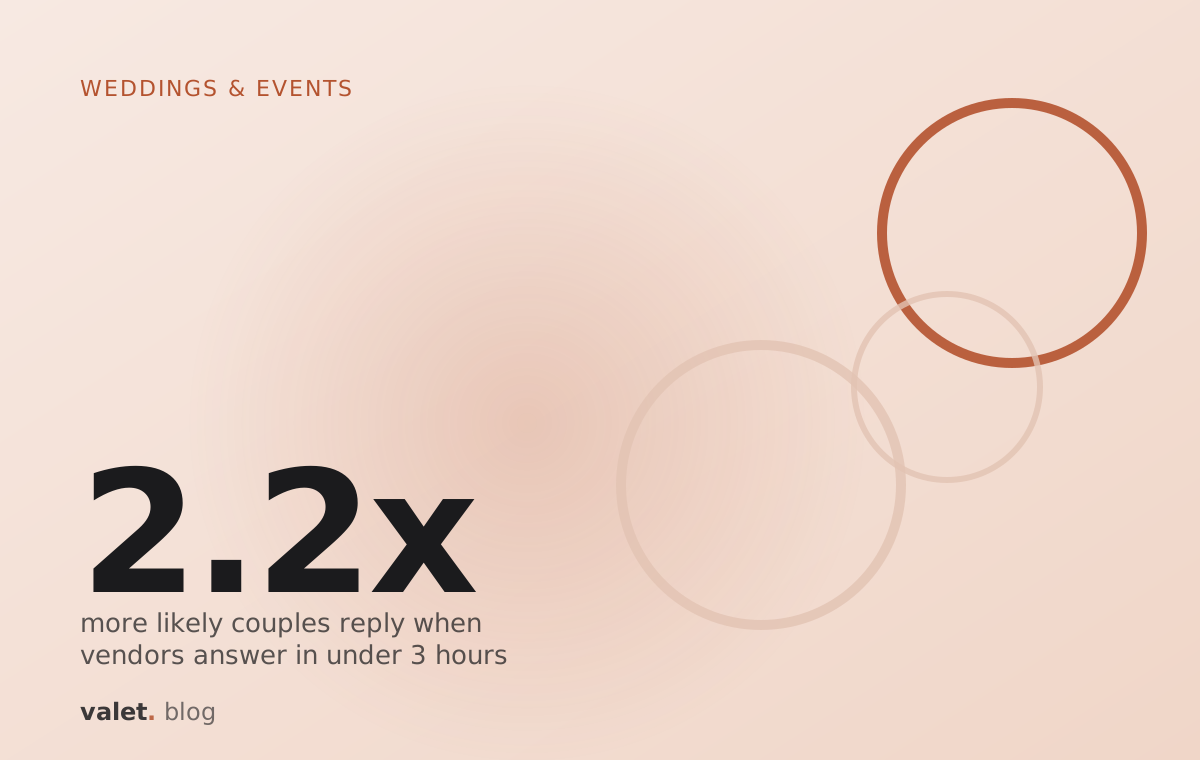
2.2x
more likely couples reply when vendors answer in under 3 hours
WeddingPro, From Hello to Hired
25%
more likely to be hired when pros replied within 30 minutes vs within 3 hours
Thumbtack, November 2025
28%
of mystery-shopped home-services businesses offered an appointment
Pied Piper, 3,211 locations, April 2026
No survey, sample or collection date was found behind "50% of couples book the first vendor who replies". The figure appears in Easy Weddings' vendor guide of May 20183 and in WeddingPro articles from 20182 and October 20211, each time without a source, beside numbers borrowed from a 2007–2011 phone-sales study4. The direction is still right: WeddingPro's own report says replies under three hours make couples 2.2x more likely to reply6. But first replies are now automated, so "first" has to mean the first useful answer, then follow-through.
The signal vendors are misreading#
The "50% book the first responder" claim is read by wedding vendors as a law of speed: answer before anyone else and half the bookings are yours. If that reading were correct, the strategy for 2026 would be simple, because instant replies now cost almost nothing. Perfect Venue's First Reply sends a personalised email about five minutes after a contact-form inquiry10. The Knot Worldwide announced "AI-powered automation tools for faster vendor responses" in April 202511. A venue agency now recommends a first response "within 60 seconds, on every channel, 24/7"12.
When every vendor can be first within a minute, being first stops separating anyone. The more useful question is what the original evidence measured, and what it says once speed is no longer scarce.
Where the 50% figure comes from: the provenance trail#
The wedding versions of the speed statistics trace back, where they trace at all, to one research programme on phone follow-up of web sales leads. The Lead Response Management study, run with MIT's James Oldroyd on InsideSales.com data, analysed "three years of data from six diverse companies, analyzing over fifteen thousand leads and more than a hundred thousand call attempts"4. It reported a "21-fold decrease in the odds of qualifying a prospect" when response stretched from 5 to 30 minutes, a fourfold drop between 5 and 10 minutes, and contact success falling "more than tenfold" in the first hour4. Harvard Business Review published a separate article by Oldroyd, McElheran and Elkington in March 20115.
Those findings describe salespeople phoning business leads. In 2018 they reached wedding education with the subject changed. Easy Weddings attributed to "MIT and InsideSales.com" the claims that waiting 10 minutes makes "a couple 4x less likely to reply", 30 minutes "21x", and one hour "600x"3. Qualification odds became a couple's reply. The 600x figure does not appear on the study page, which reports a tenfold contact drop in the first hour4. The same page states "50% of couples will book with the first supplier who responds" and "40% of couples don't hear back from suppliers within 5 days", with no source for either3.
| Year | Where | Claim | Source shown |
|---|---|---|---|
| 2007–2011 data | Lead Response Management study4 | 21x lower odds of qualifying at 30 vs 5 min; 4x drop from 5 to 10 min | Six companies, 15,000+ leads, phone calls |
| March 2011 | Harvard Business Review5 | Separate article on decay of online sales leads | Authors named; often confused with the study above |
| May 2018 | Easy Weddings3 | 50% book the first supplier; 40% no reply in 5 days; "600x" after an hour | None for 50% and 40%; "MIT and InsideSales.com" for decay |
| 2018 | WeddingPro2 | "50% of couples choose the first vendor to reply"; 40% no reply in five days | None |
| Oct 2021, updated 2026 | WeddingPro1 | "Up to 50% of all bookings go to the vendor that responds first"; 5 min = "9 times more likely to convert" | None |
| Undated | WeddingPro, From Hello to Hired6 | 5 vendors per category; under 3 h = 2.2x more likely to reply | WeddingPro's own data; method not stated |
The pattern is a familiar one in industry statistics. A finding with a narrow sample is restated with a broader subject, loses its citation in the second or third retelling, and becomes a lagging indicator of what the field believed in 2011. For the general version of this trail, including "78% buy from the first responder", see the lead response statistics, traced.
What the 2024–2026 evidence says about speed#
The newer evidence supports the direction of the old claim, with smaller and better-documented effects. WeddingPro's "From Hello to Hired" says replies sent in under three hours make couples 2.2x more likely to reply, and that couples reach out to 5 vendors per category on average6. The report does not state its method or date, so cite it with that caveat.
Outside weddings, Thumbtack reported in November 2025 that pros replying within 30 minutes were 25% more likely to be hired than those replying within three hours7. A Management Science study of more than 11 million Fiverr transactions, as reported by Entrepreneur in July 2026, found a one-hour delay cut hiring odds by 46% and a delay of 24 hours or more made a freelancer 90% less likely to win the job8. The paper itself was not read for this article.
Tripleseat's 2026 Event Intelligence Report puts the venue case in a sentence: "When a guest reaches out to three venues, the one that responds first almost always wins the date"9. It gives no number for "almost always". So the defensible reading in 2026 is this: speed raises the odds of a reply and a hire, by amounts in the range of 25% to 2.2x in the sources that show their work, and nobody has measured a 50% booking share.
Why "first" is losing its value: the first reply as a commodity#
The first reply is becoming a commodity, and the unit economics explain why. Writing a first reply from a facts sheet is cheap to automate: the date, a price range, the packages, a link. Following a thread for two weeks, holding a date, answering the deposit question and knowing when to stop is expensive, because it requires state and judgement. Perfect Venue's help centre draws the line itself: "First Reply handles the first touchpoint; everything after that is you"10.
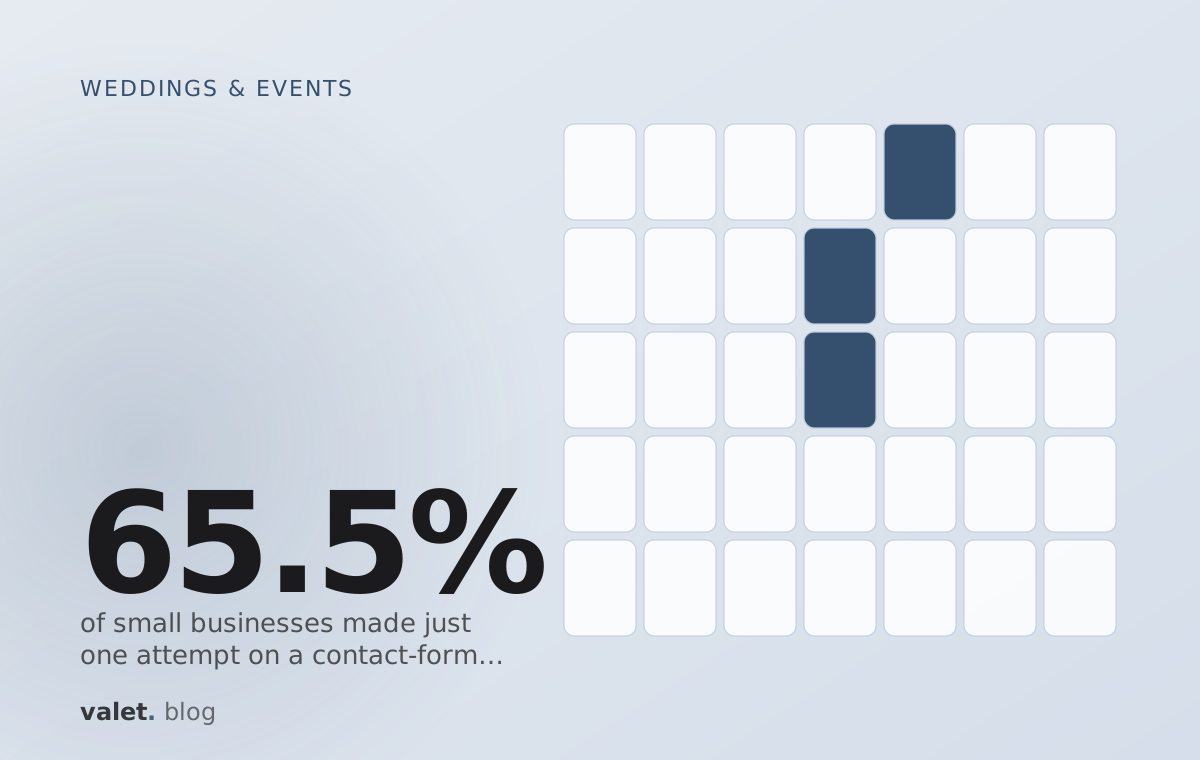
In diffusion-curve terms, instant first replies are moving from early adopters to the majority of wedding businesses that use an inquiry tool. When a capability becomes standard, the advantage moves to the adjacent step that is still scarce. Here, that step is what the first reply contains and what happens after it. Pied Piper's 2026 mystery shop of 3,211 home-services locations found 72% of inquiries received no follow-up and only 28% were offered an appointment13. Leadferno reported that 65.5% of small businesses made one attempt on a form inquiry14. Those are not wedding numbers, but they describe the step most likely to stay scarce.
What "first" has to include in 2026#
"First" in 2026 means the first reply that lets a couple make a decision without writing back to ask. WeddingPro reports that 77% of couples say pricing is the most important factor they consider before contacting a vendor6, so a reply without a price or range is not yet an answer. The test below separates a fast reply from a useful one.
| Part | Passes when the reply… | Fails when the reply… |
|---|---|---|
| 1. Date | Says whether their date is open | Says "let's check availability on a call" |
| 2. Price | Gives a price or range from your own list | Attaches nothing, or says "it depends" |
| 3. Their question | Answers what they asked, in the first lines | Answers a template instead |
| 4. A time | Offers one or two specific times to talk or tour | Says "let me know when you're free" |
| 5. The human | Says when a person will reply, if the reply is automated | Leaves the couple guessing whether anyone read it |
| 6. The next message | Is followed, if unanswered, by up to two useful follow-ups and a close | Is the only message the couple ever gets |
Score one point per part. A reply that is first in time but scores 2 or less loses to a slower reply that scores 5 or 6.
The last line of the test is a judgement, not a measurement; no published study compares reply content and speed for wedding inquiries. It follows from the evidence above: couples compare five vendors, the first reply is becoming automatic, and most businesses stop after one message.
Three scenarios for wedding inquiries through 2028#
Three scenarios describe how the value of "first" could move over the next two years. Each depends on conditions that can be watched.
Base case: instant first replies become standard, and follow-through separates vendors. If inquiry tools and marketplaces keep shipping automated first replies at the current pace, the median first reply in this trade drops to minutes. The scarce step becomes a specific time offered, a held date and a second message. Vendors who measure "time to offered slot" instead of "time to first reply" gain share.
Acceleration: AI assistants send the inquiry for the couple. BrightLocal's 2026 survey found 45% of US consumers used AI tools for local recommendations, up from 6% in 202515. If couples start asking assistants to contact vendors and compare answers, the reply that contains a date, a price and a time is the one an assistant can summarise. A reply that says "call me" drops out of the comparison.
Structural stall: distrust of leads slows replies. If vendors keep reading inquiries as fake, speed stays scarce for a different reason. Sen. Grassley's October 2025 letter to the FTC cited nearly 200 whistleblower complaints about The Knot's lead legitimacy16. In this scenario vendors filter harder, reply later to vague inquiries, and the plain first-mover advantage persists longer than the base case suggests.
Leading indicators to watch, and when this forecast expires#
Four indicators would show which scenario is winning. Each is observable by an owner or a trade publication without special data.
| Indicator | Type | Points to |
|---|---|---|
| Marketplaces and inquiry tools add follow-up or scheduling features, not only first replies | Leading | Base case |
| Inquiries arriving from AI assistants appear in vendor inboxes | Leading | Acceleration |
| FTC action, or new platform rules, on lead quality | Leading | Structural stall if delayed; base case if resolved |
| Mystery shops report "offered a time" rates for wedding vendors | Lagging | Measures whether the scarce step is closing |
This forecast expires in October 2027, or earlier if a wedding-specific mystery shop publishes reply and time-offered rates with a stated sample. If a primary source for the 50% figure surfaces, this page will cite it.
For how quickly couples give up on vendors who never answer, see why wedding vendors are so hard to reach. For the step after the first reply, see the first reply is free; the follow-up is where leads die.
Where Valet fits#
Valet is an AI assistant for a small business's written inquiries, built around the parts of the first-reply test that speed alone does not cover. It answers in minutes from the owner's own price list, packages and calendar, offers real times and holds them, and follows up at most twice by default, each time with something useful, then stops and says why. Anything not on the owner's list, such as a discount or a deposit question, waits for the owner, and the couple is told when to expect a reply. Every reply says it is AI.
To see how your own first replies score, start with the free lead check: forward 10 to 20 recent inquiries and see what went unanswered, what stopped after one reply, and what it was worth.
Questions people ask
Is it true that 50% of couples book the first wedding vendor who responds?
No source was found for it. Easy Weddings (May 2018) and WeddingPro (2018 and October 2021) state versions of it without naming a survey, sample or date. Treat it as unsourced and cite WeddingPro's 'From Hello to Hired' figures instead.
How fast should I respond to a wedding inquiry?
Within three hours at most, and faster where you can. WeddingPro reports couples are 2.2x more likely to reply when the vendor answers in under three hours, and Thumbtack found pros replying within 30 minutes were 25% more likely to be hired than those replying within three hours.
Where does 'respond within 5 minutes and you are 9 times more likely to convert' come from?
WeddingPro's 2021 lead-reply guide states it without a source. It resembles findings from the Lead Response Management study, which measured phone calls to web sales leads at six companies, not couples or wedding vendors.
What should a first reply to a wedding inquiry include?
Whether the date is open, a price or range from your own price list, an answer to the question they asked, one or two specific times to talk or tour, and when a person will reply if the first answer is automated.
Sources
Confidence: H primary source checked · M credible secondary or reported · L vendor claim or single report. Reddit and forum items are quoted from public threads and summarised, not endorsed.
- How to respond to wedding leads on The Knot and WeddingWire · WeddingPro · 2021-10-18 (updated 2026-09) M
- Still waiting to hear from a lead? Here's why · WeddingPro · 2018 (modified 2026-09-02) L
- Responding to enquiries · Easy Weddings Pro · 2018-05-23 L
- The Lead Response Management Study · Lead Response Management / InsideSales.com with James Oldroyd (MIT) · undated (page retrieved 2026-10) H
- The Short Life of Online Sales Leads · Harvard Business Review (Oldroyd, McElheran, Elkington) · 2011-03 M
- From Hello to Hired: your guide to lead replies · WeddingPro · undated H
- 3 takeaways from the 2025 Pro Summit · Thumbtack · 2025-11-06 H
- Companies are tracking response time delays for freelance jobs (Management Science study coverage) · Entrepreneur · 2026-07-16 M
- The 2026 Event Intelligence Report: data, benchmarks and blueprints for high-growth venues · Tripleseat · 2026 M
- First Reply: automated responses to new inquiries · Perfect Venue help center · 2026 H
- Taking action on feedback · WeddingPro (The Knot Worldwide) · 2025-04-02 H
- The response time benchmark every venue is failing · Indigo Digital · 2026-07-14 M
- Precision Garage Door Ranked #1 in Customer Lead Handling Effectiveness Home Services Study · Pied Piper Management Company via BusinessWire · 2026-04-12 H
- Research: website contact forms and lead management, uncovering costly mistakes · Leadferno · 2024-06-28 H
- Local Consumer Review Survey 2026 · BrightLocal · 2026 H
- Grassley presses FTC to investigate alleged fraud, deceptive business practices at wedding website The Knot · Office of Sen. Chuck Grassley · 2025-10-22 H
How to cite this page
Cite this page
Valet, "50% of couples book the first vendor who replies: where that stat comes from, and what 'first' has to include", valet.team, October 2026.
Keep reading
 Weddings & eventsWhy couples ghost after you send pricing, and what the second message should sayThe usual answers are price, a hidden price list, or a slow reply. The bigger leak is that most vendors send one reply and stop, while the couple is still choosing between five of you.Strategy desk · 12 min · 1 October 2026
 Weddings & events"Our leads from The Knot / WeddingWire never respond": ghost leads, fake leads, or leads nobody followed up?Vendors say the leads are fake. The Knot says they are templated and ghosted. A U.S. senator has asked the FTC to look. None of them has published what happened to each inquiry, and that is the only record that settles it for your listing.Policy desk · 10 min · 1 October 2026
 Weddings & eventsHow many times should you follow up with a couple who hasn't replied? (And when the lead is dead)Wedding advice runs from "one more time than you are now" to "as many times as it takes". Nobody says when to stop. Here is a stop rule, a list of lost reasons, and the three messages that sit between the first reply and the end.People at work · 11 min · 1 October 2026