
Startups & support@
The agent that remembers: account context and "what was promised" in AI support, and why most AI forgets at the handoff
A small business is held to what its assistant told a customer, yet most AI support drops that record the moment a person takes over. This piece separates what an agent must know from what it may know, and gives you a promise ledger to keep.
Short answer
AI support that remembers replies knowing who the customer is, what they asked before and what your business already promised them, and passes that record to the person who takes over. Many tools drop it at the handoff: Meta's Business Agent documentation says that on hand-back "the agent loses earlier conversation context" (360dialog, 2026). The record matters because a business can be held to what its assistant said, as Air Canada was in Moffatt v. Air Canada (2024 BCCRT 149).
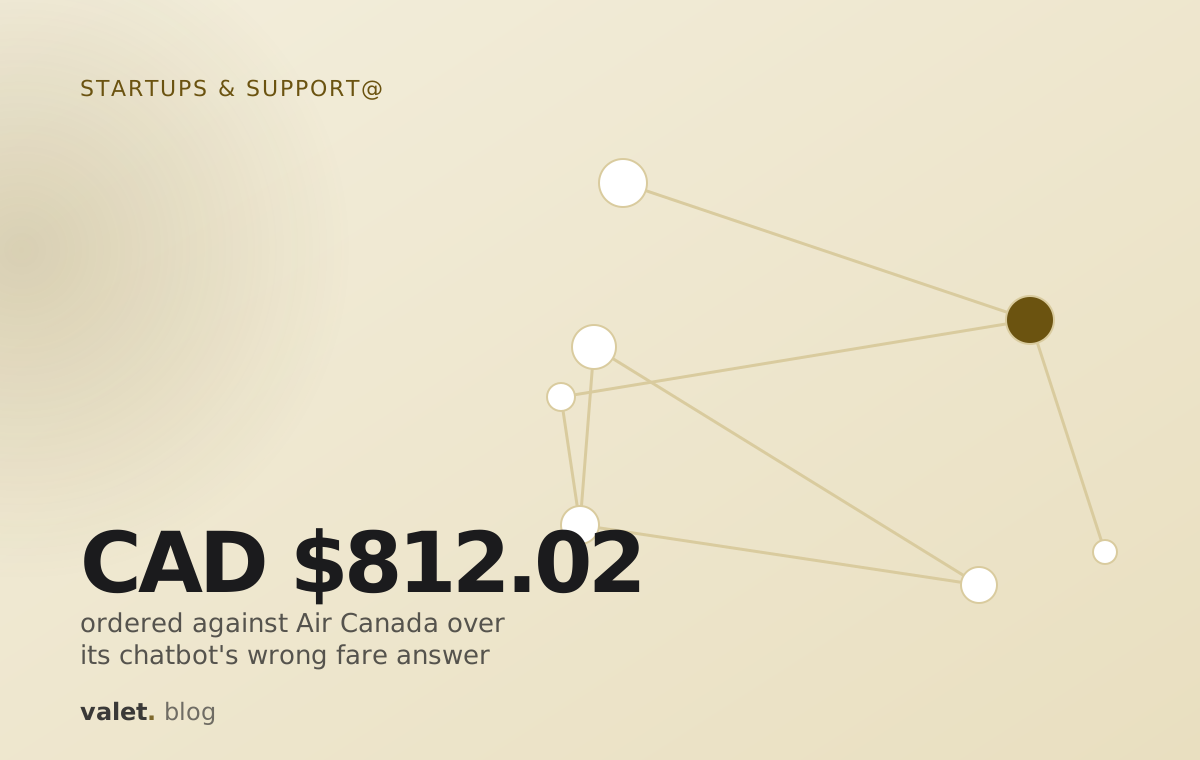
CAD $812.02
ordered against Air Canada over its chatbot's wrong fare answer
Moffatt v. Air Canada, 2024 BCCRT 149, Feb 2024
1 in 3
AI-handed-off support tickets never got a human reply
Gorgias Ecom Lab, Oct 2025 to Apr 2026 data
past 50%
bot-only containment one practitioner reported after adding account awareness
Hacker News comment, June 2026
A customer who writes to your business twice expects the second reply to know about the first. When an AI assistant answers, that expectation acquires a legal edge: in Moffatt v. Air Canada (2024 BCCRT 149), a British Columbia tribunal held the airline to its chatbot's wrong answer and ordered CAD $812.02.2 Yet the record of what an assistant said is exactly what many tools discard when a person takes over. Meta's Business Agent documentation states that on hand-back "the agent loses earlier conversation context."1 This piece sets out what an agent must know before it replies, what it should and may know, and how to keep a written record of every promise.
Not legal advice. This article describes public decisions and vendor documents as reported. Whether a statement by your assistant binds your business depends on your jurisdiction and facts. Check with counsel.
What does AI customer support that remembers actually mean?#
AI customer support that remembers is an agent that replies with three distinct records in view, and passes all three to whoever answers next. The three are often blurred together in vendor copy, so it helps to define them separately.
- Account context. The standing facts about this customer: plan or package, order or booking on file, the address they write from, anything flagged.
- Conversation history. What this customer asked before and what was answered, in which channel, and when.
- The promise record. Every commitment the business made: a quoted price, a time held, an add-on agreed, a reply-by time given, a refund said to be under review.
The demand for all three is explicit in owner and customer language. A thread in r/smallbusiness (10+ comments, September 2026) described the wanted assistant as one that "remembers every customer: what they asked, what you promised".8 On Hacker News in June 2026, one commenter praised an AI support experience because "I never have to repeat myself", and another called "has previously contacted us about something, and we want records of this" "a basic need."5 A third commenter, who ran a rollout, reported that bot-only containment "shot up past 50%" with "basic knowledge support with account awareness."5 That is one practitioner's report, not a measured benchmark, and it should be read as such.
Is a business bound by what its AI assistant told a customer?#
A business may be bound by its assistant's statements, and the public decisions so far point in that direction rather than away from it. The status of each matters, because a tribunal order, a voluntary settlement and a company apology carry different weight.
| Case | What the assistant said | Status | Outcome |
|---|---|---|---|
| Moffatt v. Air Canada, 2024 BCCRT 149 (Feb 2024) | Wrong bereavement-fare information | Decided by the BC Civil Resolution Tribunal | Argument that the chatbot was "a separate legal entity" rejected; CAD $812.02 ordered2 |
| BMW dealer, Toronto (reported Jun 2026) | Trade-in offer of CAD $27,162.79 against a best offer of CAD $20,000 | No ruling; dealer decision | Revoked, then honoured after media contact3 |
| Cursor support bot "Sam" (Apr 2025) | A device policy that did not exist | No ruling; company response | Affected user refunded; co-founder said AI email replies "are now clearly labeled as such"4 |
Three points of applicability follow. First, a Civil Resolution Tribunal decision binds its parties; it is not a statutory mandate and it does not bind courts in other provinces or states. Second, the tribunal did not treat the chatbot's separate status as an affirmative defense, and PYMNTS summarised the wider pattern in July 2026 as courts telling companies that they own what their chatbot says.11 Third, no public decision we found sets a materiality threshold below which an assistant's statement can be ignored; the Air Canada amount was small and still ordered.
The BMW case is the most instructive for memory. The Drive reported that the root cause was a figure a human employee had miscommunicated, which the bot then treated as the buyback offer.3 The failure was a record problem: the assistant held the wrong version of what had been promised, and nothing showed the dealer which version it used until the customer held them to it.
Why does AI support forget at the handoff?#
AI support forgets at the handoff because, in many products, the conversation and the human queue are separate systems, and nothing obliges the first to pass its record to the second. Vendor documentation states this plainly when you look for it. Meta's Business Agent, per 360dialog's known-limitations page, "stops answering that chat" once it hands off to a human, and on hand-back "loses earlier conversation context."1
Buyers ask the question in public. A thread in r/CRM (60+ comments, 2026) put it directly: "When AI escalates to a human, how much context actually transfers?"9 A builder in r/LLMDevs (9 comments, 2026) wrote that "Most assistants completely forget customer context between conversations".10 And the outcome of a handoff without a record is measurable: Gorgias found that one-third of support tickets handed off by AI never received a human reply, and that the median wait after handoff was 10 hours (Oct 2025 to Apr 2026 data).6
Billing definitions can make the gap worse. Fin's pricing page counts a resolution when "No further help is requested after Fin's last answer," at $0.99 per outcome.7 A customer who gives up because the agent did not know their account looks the same, under that definition, as one whose problem was solved.
Illustration What a context-less answer costs. A small SaaS company pays for 500 outcomes a month at $0.99. If 20% of them are answers that ignored the customer's account and simply ended the conversation, that is about $99 a month, or roughly $1,200 a year, paid for non-answers, before the cost of the customer writing again. The 20% is an assumption for illustration, not a measured rate.
What must an AI support agent know before it replies?#
An AI support agent must know enough to avoid contradicting the business, and no more than the reply needs. The matrix below uses the three modal levels with their ordinary force: must is a precondition for sending any reply, should is expected practice, and may is discretionary. These are operating rules for a small business, not legal obligations.
| Level | The agent knows | Why | Where it lives in your business |
|---|---|---|---|
| Must | Your current written facts: prices, packages, policies, hours | Every answer must trace to a source you wrote | |
| Must | Every open promise to this customer: price quoted, time held, add-on agreed, reply-by given | A reply that contradicts a promise creates the Air Canada problem | |
| Must | The state of this inquiry and the next step owed | Prevents a second "welcome" reply to someone mid-conversation | |
| Must | Which topics it may not answer alone: money, complaints, contracts, health, legal, safety | Those go to a person, with the customer told when | |
| Should | What this customer asked before, with dates | Stops "please repeat your question" | |
| Should | Who replied last, the assistant or a person, and what they said | The assistant must not undo a human's answer | |
| May | Account details such as plan, order or booking on file | Useful only after the sender matches the account | |
| May | Preferences the customer stated, such as a time zone | Convenience, never required |
Data-handling rule. The agent uses account details only when replying to the address or channel that owns them; it never repeats one customer's details to another sender; it keeps only the fields a reply needs; and anything it cannot trace to your written facts or to the promise record waits for you. Retention periods: set with counsel.
The order matters. A business that gives an agent account access before it writes down its prices and its open promises has built recall without a reference point, and the BMW case shows where that ends.
The promise ledger: one record per commitment#
The promise ledger is a running list of every commitment made to a customer, whoever made it, with the source and the time. It is the record a person reads before replying, and the record an assistant must check before sending. The sample below is an illustration, not a real customer.
| When | Promise | Made by | Source | Expires or due | Status |
|---|---|---|---|---|---|
| Mon 10:14 | Quoted onboarding package at the listed price | Assistant | Price list, version of 1 Sep | Quote valid 14 days | Open |
| Mon 10:14 | Held Thursday 15:00 for a setup call | Assistant | Owner's calendar | Hold until Tue 18:00 | Open |
| Tue 09:02 | "The owner will reply about a discount by Wed 12:00" | Assistant | Rule: money goes to owner | Wed 12:00 | Waiting on owner |
| Tue 16:40 | Agreed a $500 data-migration add-on | Owner, by email | Owner's reply | Invoice with first month | Open |
The fourth row is the one most systems lose, because a person agreed it outside the assistant's conversation. If that add-on is forgotten once a month, the business either waives $500 or argues with a customer who has the email; at one a month that is $6,000 a year on an illustrative basis. The ledger's rule is simple: a promise made by anyone, in any channel, goes on the same list.
What must an agent with memory never do?#
An agent with memory must never treat what it remembers as permission. Recall widens what an assistant can say, so the limits on what it may say need to be written down before access is granted. In the June 2026 Hacker News thread, one commenter raised the risk that an account-aware support bot leaks data to the wrong person.5 The rules below address that risk and the promise risk together.
- Match before you recall. Account details are used only when the sender matches the account. An unknown address asking about "my order" gets general facts and a request to write from the address on file.
- Never invent a promise. The agent may repeat a promise from the ledger. It may not extend, improve or create one; discounts, refunds and exceptions go to a person.
- Carry the record across the handoff. The person who takes over sees the conversation, the open promises and the reason for the handoff in one place, and the customer is told who replies and by when.
- Log what was used. Each reply records which facts and which ledger entries it relied on, so a wrong answer can be traced to a wrong source.
- Keep less. Store only the fields a reply needs. Privacy law on inquiry data was outside the scope of this piece; ask counsel what applies in your jurisdiction.
Questions to take to counsel#
Several questions remain unsettled, and a small business should decide them in writing rather than leave them to the next dispute. No decision we found answers them directly.
- Does a time held by an assistant, with an expiry stated to the customer, create an obligation to honour that time if the hold lapses unnoticed?
- Does labelling every reply as AI-written change how a tribunal reads a wrong statement? The public summaries relied on here do not answer that.
- If a human employee feeds the assistant a wrong figure, as in the BMW report, who in your business owns the correction?
- How long should the promise ledger and conversation history be kept, and who may read them?
For the customer-facing side of the handoff, the handoff contract sets out what the customer should be told. For what a billed "resolution" means across vendors, see what counts as an AI resolution, and for running support@ as a founder, the solo-founder runbook.
Where Valet fits#
Valet is an AI assistant for written inquiries that you forward to it; replies go out from your own address. It answers only from the facts you give it and never invents a price, discount or policy. Each inquiry sits in one of the Valet Inquiry States with a next step and a time. Every reply comes with a Valet receipt: what was asked, the rule used, the sources used and where it was sent from, which is the written record a person reads before stepping in. Money, complaints and contracts go to you with one-tap replies, and the customer is told when you will reply. Valet does not read the rest of your inbox, and messages are not used to train AI models. To see what your current replies remember and forget, start with the free lead check.
Questions people ask
What does it mean for AI customer support to remember the customer?
It means the agent replies with three things in view: the customer's account facts, the earlier conversation, and any commitment the business already made, such as a quoted price, a held time or an agreed add-on. The same record must reach the person who takes over.
Why does the chatbot ask me to repeat everything after it hands me to a person?
Because many tools do not pass the conversation across. Meta's Business Agent documentation, for example, says the agent stops answering a chat once it hands off and loses earlier conversation context on hand-back (360dialog docs, 2026).
Is my business responsible for what its AI assistant promised a customer?
It may be. In Moffatt v. Air Canada (2024 BCCRT 149) a British Columbia tribunal rejected the argument that the chatbot was a separate legal entity and ordered CAD $812.02. That decision binds only its parties, so check with counsel about your own jurisdiction. This is not legal advice.
What should an AI support agent never remember or repeat?
It should not reveal one customer's details to another sender, quote account data to an unverified address, or carry forward a promise nobody in the business made. Keep only the fields a reply needs, and decide how long you keep them with counsel.
Sources
Confidence: H primary source checked · M credible secondary or reported · L vendor claim or single report. Reddit and forum items are quoted from public threads and summarised, not endorsed.
- Meta Business Agent: known limitations · 360dialog docs · 2026 H
- A word of caution: company liable for misrepresentations made by chatbot (Moffatt v. Air Canada, 2024 BCCRT 149) · McMillan LLP · 2024-02 H
- BMW dealer forced to pay $5,000 extra for used X3 over AI chatbot error · The Drive · 2026-06 H
- Cursor AI support bot invents fake policy and triggers user uproar · Ars Technica · 2025-04-17 H
- Discussion thread on the Salesforce acquisition of Fin (comments by janderson215, rtpg, madrox, dezgeg) · Hacker News · 2026-06 H
- The cheapest ticket is the one a human never touches · Gorgias Ecom Lab · 2026 H
- Fin pricing · Fin (Intercom) · 2026-10-01 H
- "how much of your day is the same 20 questions" (10+ comments; Google snippet) · Reddit, r/smallbusiness · c. 2026-09 M
- "Best AIs for customer support? Tested a bunch." (60+ comments; Google snippet) · Reddit, r/CRM · c. 2026-03 M
- "We Built an AI Sales Assistant That Actually Remembers" (9 comments; Google snippet) · Reddit, r/LLMDevs · c. 2026-06 M
- Courts to companies: you own what your chatbot says · PYMNTS · 2026-07-01 H
How to cite this page
Cite this page
Valet, "The agent that remembers: account context and 'what was promised' in AI support", valet.team, October 2026.
Keep reading
 Startups & support@Should a startup use AI for customer support? What founders who lost customers say, and the three missing controlsCustomers accept AI support when they can reach a person. The failures that cost startups customers trace to three missing controls, not to the model.Data desk · 11 min · 1 October 2026
 Startups & support@How to handle support@ as a solo or 3-person SaaS founder (without hiring, and without a bot that traps people)Sort support@ into four categories, give each a written promise and an automation level, and check the handoffs every week. Here is the runbook, plus the six ways it breaks.Playbooks · 12 min · 1 October 2026
 Startups & support@An AI agent that answers vs one that finishes the job: what "acts" means for a small business, and the four controls that make it safeMost AI tools sold to small businesses answer the first message and stop. This piece defines what it means for an agent to finish the job, traces where answer-only tools lose the inquiry, and sets out the four controls that make acting safe.Technical desk · 11 min · 1 October 2026