
Tools & pricing
AI receptionist free trials and annual plans: the $299-on-day-8 problem
Card-up-front trials and annual plans are sold as low-risk. For a front-office tool they move the risk of a tool that does not work onto the owner, before the evidence arrives. Here is the argument, the terms, and the checklist.
Short answer
A card-up-front free trial and an annual plan that auto-renews both shift the risk of a front-office tool not working from the vendor to you. A Trustpilot reviewer of My AI Front Desk says they were charged $299 on day 8 of a 7-day trial (June 2026). Podium's MSA, as quoted by FieldCamp (August 2026), sets a 12-month auto-renewing term, one month's written notice and non-refundable fees. Check term, notice, refund and cancel route before you enter a card.
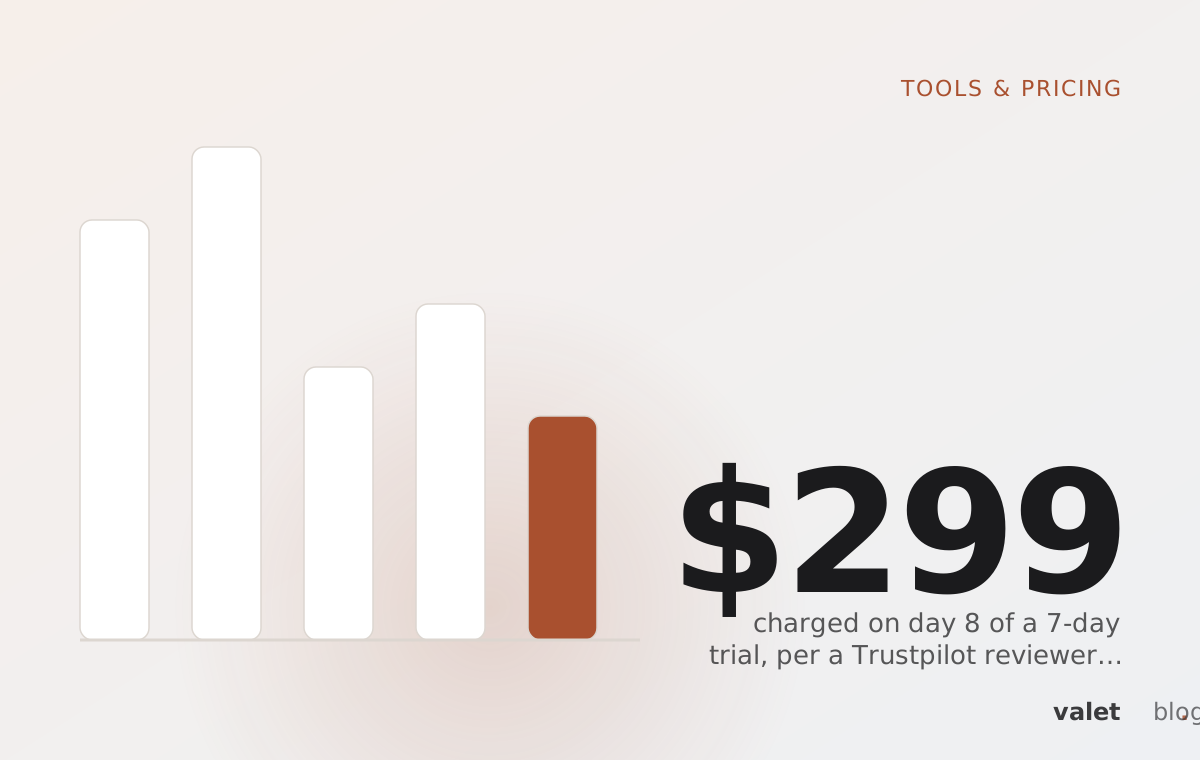
$299
charged on day 8 of a 7-day trial, per a Trustpilot reviewer of My AI Front Desk
Trustpilot, 4 Jun 2026
12 months
Podium's initial term, auto-renewing, with one month's written notice to stop it
Podium MSA §8.1 via FieldCamp, 31 Aug 2026
~$508/mo
Podium Core at one location with common add-ons, before SMS overages
Astucia, Jun 2026 (updated Jul 2026)
A card-up-front free trial and an annual plan that renews unless you give notice look like two separate offers. For a front-office tool they do the same job: they move the risk that the tool does not work from the vendor to you, before you have the evidence to judge it. A Trustpilot reviewer of My AI Front Desk says they signed up for a 7-day trial that required a card and "On day 8, I was charged $299."1 Podium's master services agreement, as quoted by FieldCamp, sets a 12-month auto-renewing term with one month's written notice and fees that are "non-refundable and non-creditable."2
The fix is not to avoid trials. It is to read four terms before entering a card, and to prefer pricing that charges when the tool produces something you can check.
What the trial-and-annual consensus says, stated fairly#
The mainstream view of software buying holds that a free trial is the buyer's protection and an annual plan is the buyer's discount. You try the product for a week at no cost, and if it works you commit for a year at a lower monthly rate than month-to-month. If you forget to cancel, that is an administrative slip, not a structural problem.
For most software that view is reasonable. A design tool or an accounting package shows whether it fits within days, because you are the user and you see the output every time you open it. The trial period and the evidence period are the same length.
AI receptionists and front-office tools are sold on the same terms. Astucia reports that "Every plan requires an annual contract" at Podium, with Core at about $399 a month and Pro at about $599.3 Card-up-front trials appear in the reviews below, and they show what happens at the edges.
Why vendors and careful buyers both believe it#
The consensus survives because it serves both sides of the table at the moment of signing. Vendors carry real onboarding costs: phone numbers, integrations, training the system on a business's details. An annual term spreads that cost and lowers churn, which lets the vendor quote a lower monthly price than it could on a monthly plan.
Buyers accept it because the discount is visible and the risk is not. A $399 line on a quote is concrete. The probability that the tool mishandles a share of your inquiries is abstract, and nobody prices it into the decision. A card taken at the start of a trial also looks harmless, since the buyer intends to cancel if the product disappoints.
There is a third reason, which is less flattering. A card on file at the start of a trial converts better than a request for payment at the end. A comment in an r/gohighlevel thread titled "Just Closed My Agency" (70+ comments) describes taking the card straight away "so when they inevitably forget to cancel the trial" the charge goes through.7 That is the seller's logic stated plainly: conversion depends partly on inattention.
The cracked assumption: a front-office tool cannot prove itself in seven days#
The consensus assumes that the evidence of whether a tool works arrives inside the trial. For a front-office tool, it usually does not, for three reasons that compound.
First, setup eats the trial. One My AI Front Desk reviewer on Trustpilot (27 March 2026) says they paid for an annual subscription upfront "After a few days of a free trial," then asked for a refund, and that the company "declined, citing the annual contract." The same reviewer describes "30+ hours setup" before that point.1 Hours spent configuring are hours in which no real customer is handled.
Second, volume is too low to judge. Illustration A business that receives 12 inquiries a month sees about three in a 7-day trial. Three conversations cannot show you whether the tool books, whether it hands off cleanly, or whether it says something you would not have said. The tool's failure rate becomes visible only across dozens of inquiries.
Third, the failures that cost money are slow. A tool that answers the first message and never follows up looks fine on day 3. The loss shows up weeks later as quotes that went quiet. Pied Piper's 2026 study of 3,211 home-services inquiries found 72% got no follow-up and 28% were offered a time.10 A follow-up gap of that kind cannot be seen in a week.
Put together, the trial ends before the evidence starts, and the annual term begins at the point of maximum ignorance. This is a principal-agent problem in its plainest form: the vendor is paid the same whether the tool books customers or quietly loses them, and the buyer carries the second-order effect.
The alternative mechanism in one sentence#
Pay on terms that let you leave cheaply, and on units you can check yourself, so the vendor carries the risk that the tool does not work.
In practice that means month-to-month billing, a cancellation route you can use without a phone call, a refund window longer than the setup period, and where possible a price tied to an outcome you can verify, such as a booking on your calendar, rather than to time elapsed.
Three lines of evidence, strongest last#
The first line is the owner record on review sites. Beyond the $299 charge, a second My AI Front Desk reviewer (28 March 2026) writes: "I paid them $1,428 for the subscription so that I could actually do a real trial of the product...they're refusing to give me back my money."1 The site lists 18 reviews and a 3.5 average, so this is a small sample, and these are the reviewers' accounts, not findings. They do show the pattern: the trial was too short to judge, so the buyer paid for a year to find out.
The second line is Podium's review history. A Trustpilot reviewer (13 February 2026) writes: "you get locked into 12 months, so you can't even cancel."4 On Capterra, a 2024 reviewer reports Podium "acknowledged cancellation and then proceeded to continue billing."9 On Birdeye, the only evidence we have is a thread in r/smallbusiness, "Birdeye for reviews" (20+ comments, about a year old), where an owner describes "monthly payments but a year contract."8 We could not read Birdeye's own terms.
The third and strongest line is the contract text itself, because it does not depend on anyone's account. As quoted by FieldCamp on 31 August 2026, Podium's MSA §8.1 says "the initial term for any Subscription to the Services is twelve (12) months and will automatically renew for subsequent periods of equal duration," requires "written notice of non-renewal at least one (1) month before the end of the then-current Subscription Term," and lets the client give notice "by sending an email to [email protected]."2 The same summary quotes trial terms: such services "will convert to a paid Subscription." Fees are "non-refundable and non-creditable, except as expressly set forth in Sections 2.3 and 8.3."
What that costs. Astucia's single-location example, Core plus two extra numbers, the 10DLC fee and the AI Employee add-on, "lands at approximately $508/month before any SMS overages."3 Twelve months of that is about $6,100, committed before the tool has handled a busy season.
Where the annual plan still wins#
The consensus is right in a narrower case than it claims. An annual plan is a sound capital allocation when you have already run the tool for a full cycle of your business, your inquiry volume is stable, and the discount is larger than the value of being able to walk away. At that point the evidence exists and the risk is priced.
Month-to-month is also not a guarantee of good terms. Smith.ai's pricing page says "Smith is a month-to-month service," that on cancellation "we bill for and through the end of the current monthly billing cycle," and that "If you decide Smith.ai isn't for you in the first two weeks, we'll refund your initial plan."5 A competitor's blog reports a 30-day email notice requirement and a $1,000 cap on the guarantee, which the pricing page summary we read does not state in the same way.6 Read the terms page, not the summary. The same applies to what a tool does once it is live; our 12 questions for an AI vendor cover handoff, receipts and undo.
Where I'd be wrong, and the checklist before you enter a card#
This argument fails if a vendor offers a trial long enough to cover your slow and busy weeks, takes no card until you choose to pay, lets you cancel in the product, and refunds pro rata. Some do. If the vendor you are considering meets all four, the trial is what the consensus says it is, and you should judge the product on its handling of real customers.
For everyone else, the Monday-morning decision is a short checklist. The table records what we could verify on 1 October 2026.
| Question | Podium | Smith.ai | My AI Front Desk | Birdeye | Your vendor |
|---|---|---|---|---|---|
| Minimum term? | 12 months, auto-renewing (MSA §8.1 via FieldCamp) | "month-to-month" (smith.ai) | Not verified; reviewers describe annual upfront plans | Not verified; one owner thread: "a year contract" | |
| Notice to stop renewal? | 1 month, written, to [email protected] | Bills through current cycle; a competitor blog reports 30-day email notice | Not verified | Not verified | |
| Refunds? | "non-refundable and non-creditable" with stated exceptions | Initial plan refunded if you leave in the first two weeks | Reviewers report refunds declined on annual plans | Not verified | |
| Does the trial convert to paid? | Yes: "will convert to a paid Subscription" | Not applicable (guarantee instead) | Reviewer: charged $299 on day 8 of 7 | Not verified | |
| Typical monthly cost? | Core ~$399; ~$508 single-location example (Astucia) | $300 for 30 calls, plus per-call add-ons | Not verified | Not verified |
- Write down the trial end date and set a reminder two days earlier.
- Find the cancellation route in writing: in-app, email address, or phone only.
- Ask for the terms page link and read the term, renewal and refund clauses yourself.
- Ask whether the trial converts automatically, and to what plan and price.
- Count how many real inquiries the trial will see. If it is fewer than 20, the trial cannot show you the failure rate.
- Prefer month-to-month until the tool has run through one busy period.
Sources: Podium MSA via FieldCamp2; Astucia3; smith.ai5; ServiceAgent.ai6; Trustpilot1; r/smallbusiness snippet8.
Where Valet fits#
Valet is not a phone receptionist. It answers a small business's written inquiries: email, website forms, marketplace lead emails and requests on a free Valet page. On the terms this piece cares about, Valet is month to month during early access, priced as a small monthly base plus a fee only for bookings or quotes Valet wins, capped monthly. Before any of that, the free lead check costs nothing: forward 10 to 20 recent inquiries, or show them on a call, and see which went unanswered, which stopped after one reply, and what they were worth. That gives you the evidence a 7-day trial usually does not.
Questions people ask
Do AI receptionist free trials charge you automatically?
Many require a card and convert to a paid plan unless you cancel in time. Podium's MSA, as quoted by FieldCamp, says trial services "will convert to a paid Subscription." A My AI Front Desk reviewer on Trustpilot reports being charged $299 on day 8 of a 7-day trial in June 2026.
How do I cancel Podium?
According to the MSA text FieldCamp quotes (August 2026), you send written notice of non-renewal to [email protected] at least one month before the end of the current 12-month term. Missing that date renews the subscription for another term, and fees are described as non-refundable.
Is Smith.ai a contract?
Smith.ai's pricing page says it is month-to-month with no long-term contracts, bills through the end of the current monthly cycle if you cancel, and offers to refund your initial plan if you decide in the first two weeks it is not for you (smith.ai, checked 1 October 2026).
Is an annual plan for an AI receptionist ever worth it?
It can be, once you have run the tool for a full busy season, your inquiry volume is stable, and the annual discount is larger than the value of being able to leave. Signing one before the tool has handled real customers is a bet made without evidence.
Sources
Confidence: H primary source checked · M credible secondary or reported · L vendor claim or single report. Reddit and forum items are quoted from public threads and summarised, not endorsed.
- Frontdesk AI (My AI Front Desk) reviews · Trustpilot · 2026-03-27 to 2026-06-04 (checked 2026-10-01) H
- How to cancel Podium · FieldCamp (quoting the Podium MSA) · 2026-08-31 M
- Podium pricing 2026: what SMBs actually pay · Astucia · 2026-06-15 (updated 2026-07-08) M
- Podium reviews, page 9 · Trustpilot · 2026-02-13 H
- Smith.ai pricing · Smith.ai · checked 2026-10-01 H
- Smith.ai pricing explained · ServiceAgent.ai (competitor blog) · 2026 M
- "Just Closed My Agency" (thread, 70+ comments; Google snippet) · Reddit, r/gohighlevel · c. 2026 M
- "Birdeye for reviews" (thread, 20+ comments; Google snippet) · Reddit, r/smallbusiness · c. 2025 M
- Podium reviews, page 3 · Capterra · 2023-2024 H
- Precision Garage Door Ranked #1 in Customer Lead Handling Effectiveness Home Services Study (Pied Piper PSI 2026) · BusinessWire / Pied Piper Management Company · 2026-04-12 H
How to cite this page
Cite this page
Valet, "AI receptionist free trials and annual plans: the $299-on-day-8 problem", valet.team, October 2026.
Keep reading
 Tools & pricingWhat counts as an AI "resolution"? Seven vendors' billing definitions, side by sidePer-resolution pricing is only as fair as its definition. Here is what Fin, HubSpot Breeze, Zendesk, Help Scout, Gorgias, Tidio Lyro and Clio Grow AI each bill as a resolution or outcome, what you can verify yourself, and why Intercom declined to price per booking.Policy desk · 11 min · 1 October 2026
 Tools & pricingFirst-reply tools compared (2026): Meta Business Agent, Podium, Perfect Venue, GoHighLevel, HoneyBook AI, Tripleseat, Calendly Callie, Google's GBP agent, and what happens after the first replyEvery tool on this list can send the first reply. We read their pricing pages and help docs to see which ones send the second, what they charge for it, and what you sign.From the Valet team · 10 min · 1 October 2026
 Tools & pricingPerfect Venue First Reply and AI Reply (and Perfect Venue vs Tripleseat): "everything after that is you"Perfect Venue's help centre describes First Reply in one honest sentence. This is a teardown of the inquiry path around that sentence: which inquiries trigger it, what happens at minute six, and where the second message has to come from.Technical desk · 9 min · 1 October 2026