
Trust & AI handoff
The handoff gap: one-third of AI-handed-off tickets never get a human reply. How to measure yours, and what "resolved" should mean
AI support vendors report resolutions. Customers experience handoffs. This runbook measures the gap between the two in your own helpdesk in about 90 minutes, and gives you six ticket states you can verify without the vendor's word.
Short answer
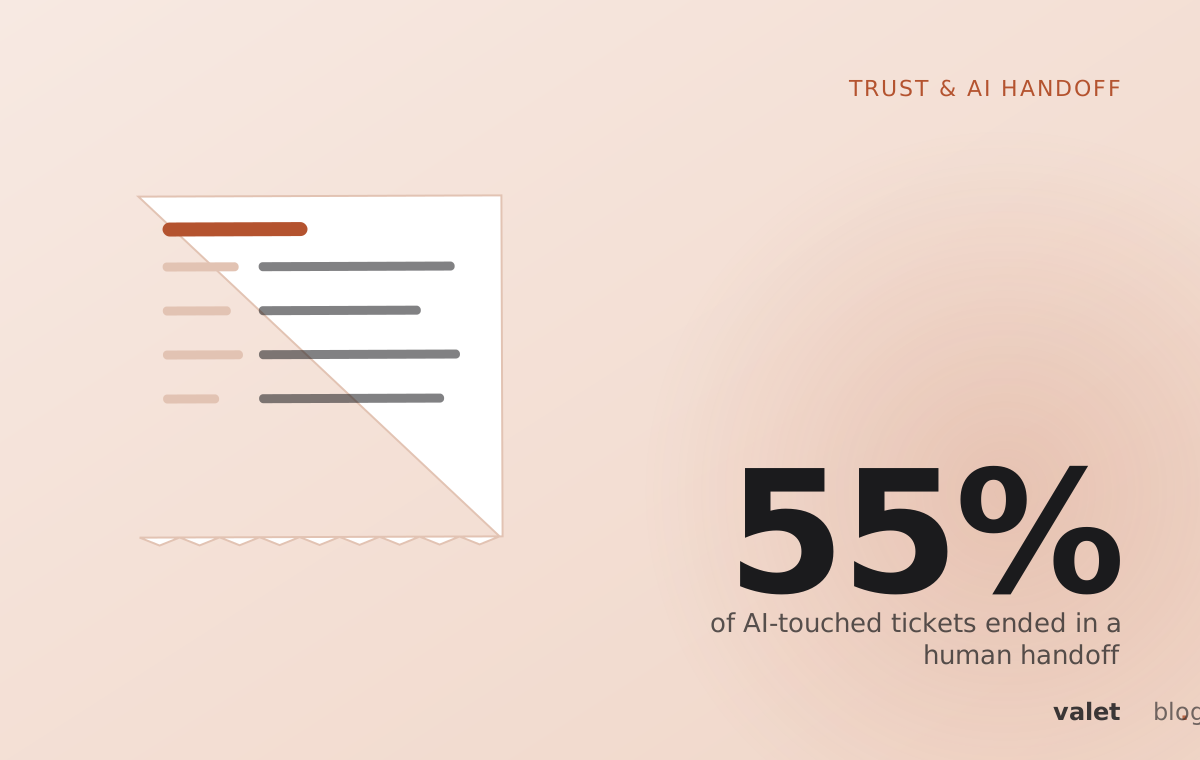
A deflected ticket ended without a person; a resolved ticket ended with the customer's problem fixed. Most AI billing cannot tell them apart. Gorgias's platform data (Oct 2025 to Apr 2026) found 55% of AI-touched tickets ended in a human handoff, the median wait after handoff was 10 hours, and 33% of handed-off tickets never got a human reply. Measure your own handoff rate, wait and abandonment before you trust a resolution rate.
55%
of AI-touched tickets ended in a human handoff
Gorgias Ecom Lab, accounts with 200+ AI-touched tickets, Oct 2025–Apr 2026
33%
of handed-off tickets never received a human response
Gorgias Ecom Lab, published 28 Apr 2026
42% / 30% / 13%
handoff abandonment on contact form / email / chat
Gorgias Ecom Lab, 2026
A deflected ticket ended without a person. A resolved ticket ended with the customer's problem fixed. Most AI billing cannot tell the two apart. Gorgias's own platform data shows why that matters: 55% of AI-touched tickets ended in a human handoff, the median wait after handoff was 10 hours, and 33% of handed-off tickets never got a human reply at all.1
This runbook measures the same three numbers in your helpdesk. It takes about 90 minutes. At the end you will have your own handoff rate, your own wait, your own abandoned count, and a written definition of "resolved" that you can check without the vendor's word.
What the Gorgias handoff numbers say#
The Gorgias handoff study is the largest public measurement of what happens after an AI passes a ticket to a person. It covers Gorgias merchants from October 2025 to April 2026, in accounts with 200 or more AI-touched tickets, published 28 April 2026.1
| Measure | Result |
|---|---|
| AI-touched tickets that ended in a human handoff | 55% |
| Median wait once a ticket crossed to a human | 10 hours |
| 90th-percentile wait after handoff | 71 hours |
| Handed-off tickets that never got a human response | 33% |
| Contact form: time to resolution / abandoned | 36 hours / 42% |
| Email: time to resolution / abandoned | 32 hours / 30% |
| Chat: time to resolution / abandoned | 8 hours / 13% |
Source: Gorgias Ecom Lab, "The cheapest ticket is the one a human never touches", 28 April 2026.1 Gorgias defines abandonment as a handed-off ticket with no later human response.
Read the 90th percentile twice. One handoff in ten waited about three days. Email and contact forms, the channels most small teams run from a shared inbox, lost the most.
Gorgias draws its own conclusion: "The only exit is fewer handoffs."1 That is half right. Fewer unneeded handoffs is a fair goal. But the handoffs that remain are money questions, complaints and the hard cases. Those need a person who replies.
What the gap costs a small store#
The handoff gap turns into a monthly count you can picture. Illustration Take a 300-order apparel store. Gorgias reports about 22 tickets per 100 orders for apparel and accessories.2 That is 66 tickets a month. Assume every one is AI-touched. At Gorgias's rates, about 36 hand off and about 12 never get a human reply. Twelve customers a month asked for a person and heard nothing.
Deflected, answered, resolved: what each word means#
A ticket state is only useful if you can check it from your own records. Vendors bill on their own definitions, and most of them count a customer who went quiet as a success.
- Fin bills an outcome when "No further help is requested after Fin's last answer."3
- Gorgias bills when "the AI resolves a customer conversation entirely on its own. The customer asks something, the AI handles it, the conversation closes."4 Its research defines AI resolution rate as the share of AI-touched tickets closed without a human agent message.1
- Help Scout counts a resolution "only if the customer receives an AI response and doesn't use escalation, search the knowledge base, ask more questions, or indicate that they need more help."5
- HubSpot Breeze reportedly treats a conversation as resolved when there is no human handoff within 72 hours. That wording comes from a secondary source; check it on a HubSpot page.6
None of these definitions asks whether the answer was right. Under "no further help requested", a helped customer and a customer who gave up look the same. A thread in r/webdev (60+ comments, about November 2025) put it bluntly: an AI whose promises the company will not stand behind "isn't 'support', it's a deflection layer."7 For the full vendor-by-vendor comparison, see what counts as an AI resolution.
Use the six states below instead. Each one names the evidence that proves it.
| State | Plain definition | Evidence that proves it | Vendor terms that may count it as "resolved" |
|---|---|---|---|
| Deflected | The ticket ended with no person involved. Nobody knows if the customer was helped. | None. Silence is not evidence. | Fin "no further help is requested"; Gorgias "the conversation closes" |
| Answered | A reply went out that matches your written facts. | The reply, checked against your price list, policy or help article. | All of the above, if no follow-up came |
| Resolved | The customer's problem is finished. | The customer confirmed, or an event exists in your records: order changed, refund issued per policy, replacement shipped. | Help Scout's rule comes closest, because a customer's own action removes the charge |
| Booked | The inquiry became a sale, appointment or order. | A calendar event, order or signed quote you can open. | Rarely billed this way by AI support vendors |
| Handed off | A named person owns the ticket, and the customer was told when they will reply. | Owner name and reply-by time written in the thread. | HubSpot (reported): resolved if no handoff within 72 hours |
| Abandoned | Handed off, then no human reply ever came. | No human message after the handoff timestamp. | Can close on a timer and look like a resolution |
Vendor wording from each vendor's pricing page or post, read 1 October 2026; HubSpot via Resolve247 (confidence M). Abandonment as defined by Gorgias Ecom Lab, 2026.
Before you start: prerequisites and the use-this-if filter#
The audit needs admin or reporting access to your helpdesk, a spreadsheet, and 30 days of AI-touched tickets. Check these before you export anything.
Use this runbook if an AI agent replies to your customers by email, form or chat, and your helpdesk logs when a ticket moves from the AI to a person. Do not use it if the AI only drafts replies that a person sends. In that case every ticket is human-handled, and the handoff gap does not apply.
- Confirm your role. You need permission to export tickets with timestamps. If the export button is missing, ask the account owner for a reporting role. Do not proceed with screenshots.
- Find the handoff field. Look for a handoff event, a tag the AI adds, or an assignment change from the AI to a team member. If none exists, stop. Ask your vendor how a handoff is recorded. You cannot measure what is not logged.
- Find the first human reply time. Your export must show when a person first wrote back. A "first response time" that counts the AI's reply will hide the gap.
- Check the volume. Gorgias measured accounts with 200 or more AI-touched tickets.1 Under about 50 tickets, treat your results as a rough read, not a benchmark.
How to measure your handoff gap, step by step#
The measurement takes seven steps. Each step has a check. If a check fails, fix it before you move on.
- Export 30 days of AI-touched tickets. Include: created time, channel, handoff time, first human reply time, closed time, close reason. Check: your row count matches the AI ticket count on your dashboard. If it does not, look for merged tickets or a channel filter.
- Count handoffs. Divide tickets with a handoff time by all AI-touched tickets. That is your handoff rate. Gorgias's figure is 55%.1 Check: spot-read five handoffs to confirm the field means what you think.
- Measure the wait. For each handoff with a human reply, subtract handoff time from first human reply time. Sort the column. Take the middle value (median) and the value 90% of the way down (90th percentile). Compare with 10 hours and 71 hours.
- Count abandoned tickets. Count handoffs with no human reply at all. Divide by all handoffs. Compare with 33%. Split the count by channel and compare with 42% for forms, 30% for email and 13% for chat.1
- Read 20 "resolved" tickets. Pick them at random from tickets the AI closed. Label each one with a state from the table above. Check: count how many you could prove as answered, resolved or booked. The rest are deflected.
- Price what you paid for. Multiply last month's billed resolutions by your unit price. Then apply your deflected share from step 5. That is your estimate of what you paid for silence.
- Write your definition down. Put one sentence at the top of your weekly report, such as: "Resolved means the customer confirmed, or an order, refund or booking exists." Report handoffs, wait and abandoned next to it, every week.
The three most common failure modes, and the fix for each#
The audit usually surfaces the same three faults. Each one has a cause you can see in the export and a fix you can make the same week.
Failure 1: silence is counted as resolved#
A ticket that closes on a timer, after the customer stops writing, counts as an AI resolution under most billing rules. The customer may have bought elsewhere. A founder in r/micro_saas titled a September 2026 thread "We lost 56 customers after I tried to save money with AI" (240+ comments); one line in Google's snippet said to "escalate to a human when it detects the AI is stuck on a loop."8 A G2 reviewer wrote in September 2026 that "Fin can sometimes get stuck in feedback loops," leaving "customers feeling frustrated."9
Fix: Split auto-closed tickets with no last customer message into their own line, labelled "unknown". Do not add them to resolved. If your vendor bills them, ask for a dispute path.
Failure 2: the handoff lands in a queue nobody owns#
A handoff that lands in an unassigned view waits until someone happens to look. That is how a third of handoffs end with no reply. A July 2026 Trustpilot reviewer described an AI that "closed tickets without proper replies."10
Fix: Route every handoff to one named person by rule, with a backup for days off. Tell the customer a reply-by time in their time zone. Set an alert at that time. Never write "someone will be in touch."
Failure 3: the customer has to start again#
A handoff without context makes the customer repeat the whole story. Many quit instead. Check five handed-off tickets: could the person reply without scrolling the full transcript?
Fix: Add a short context note at handoff: who the customer is, what they asked in their own words, what the AI already said, what it promised, and why it handed off. The handoff contract has a template you can copy.
Trap. Do not "fix" a high handoff rate by raising the AI's confidence threshold so it answers more. That moves tickets from handed off to deflected. Your resolution rate goes up. Your abandoned customers do not go away; they stop showing up in the report.
Rollback and the weekly health check#
Set a rollback trigger before you change anything. A reasonable trigger: abandoned handoffs above 10% of handoffs for one full week, or any money promise the AI made that you did not authorise.
- Roll back by topic, not all at once. Find the two topics with the most abandoned handoffs. Switch the AI to draft-only or off for those topics. Leave the rest running.
- Reopen the abandoned tickets. Reply to each one from a person. Apologise in one line, answer the question, and give a time if anything is still open.
- Re-run steps 2 to 4 after seven days. Check that abandoned is falling and that the median wait is under your stated reply-by promise.
- Keep the weekly line. Handoff rate, median wait, 90th-percentile wait, abandoned count, and your definition of resolved. Five numbers, one line, every Monday.
Where Valet fits#
Valet handles written inquiries for small businesses: email, website forms and listing leads forwarded to it. Every inquiry has a state, a next step and a time in the Valet Inquiry States: New, Answered, Time held, Followed up, Booked, or closed with a reason logged. Money questions, complaints, contracts and anything not in the owner's facts go to the owner with one-tap replies, and the customer is told when the owner will reply. Each reply carries a Valet receipt showing what was asked, the rule used and the sources. Valet has not published handoff or owner-reply numbers; with receipts, it could report both. To see where your own inquiries stall, start with the free lead check: forward 10 to 20 recent inquiries and see which went unanswered or stopped after one reply.
Questions people ask
What is the difference between deflection and resolution in customer support?
A deflected ticket ended without a human taking part; nobody knows whether the customer was helped. A resolved ticket ended with the customer's problem fixed, which you can check against a confirmation or an event in your own records, such as an order change or a booking.
What happens when an AI chatbot hands off to a human?
The ticket moves to a human queue. In Gorgias's 2026 platform data, the median wait from that moment was 10 hours, the 90th percentile was 71 hours, and one in three handed-off tickets never got a human reply.
Which channel loses the most handed-off tickets?
Contact forms. Gorgias found 42% of contact-form handoffs were abandoned, against 30% for email and 13% for chat (Oct 2025 to Apr 2026).
How do I measure my own AI handoff gap?
Export 30 days of AI-touched tickets with the handoff time and the first human reply time. Count handoffs, compute the median and 90th-percentile wait, and count handoffs with no human reply at all. Then read a sample of the AI's 'resolved' tickets and check each one.
Should I aim for fewer handoffs?
Fewer unnecessary handoffs, yes. But a handoff that reaches a named person with a reply-by time is a good outcome, and a hidden handoff counted as a resolution is a bad one. Report handoffs kept as well as handoffs avoided.
Sources
Confidence: H primary source checked · M credible secondary or reported · L vendor claim or single report. Reddit and forum items are quoted from public threads and summarised, not endorsed.
- The cheapest ticket is the one a human never touches · Gorgias Ecom Lab · 2026-04-28 H
- Ticket volume · Gorgias · 2026-05-22 H
- Fin pricing · Fin (formerly Intercom) · 2026-10-01 H
- AI Agent pricing · Gorgias · 2026-05-28 H
- Help Scout pricing · Help Scout · 2026-10-01 H
- HubSpot Breeze pricing change · Resolve247 · 2026-04 M
- "If your AI support system promised user refund, should you?" (60+ comments; Google snippet) · Reddit, r/webdev · c. 2025-11 M
- "We lost 56 customers after I tried to save money with AI [support]" (240+ comments; Google snippet) · Reddit, r/micro_saas · c. 2026-09 M
- Intercom reviews (cons) · G2 · 2026-09 H
- Gorgias reviews · Trustpilot · 2026-07 H
How to cite this page
Cite this page
Valet, "The handoff gap: one-third of AI-handed-off tickets never get a human reply", valet.team, October 2026.
Keep reading
 Trust & AI handoffThe customer who fired a contractor over a bot: what "never stuck with a bot" has to meanA homeowner dropped a plumber because the AI receptionist could not pass him to a person. The public cases since then show where handoffs break, and what a working one has to promise.Field reports · 11 min · 1 October 2026
 Trust & AI handoffCan a quote from my AI be binding? What BMW Toronto taught every business that prices by emailA chatbot at a Toronto BMW dealer offered a customer about CAD $7,000 more than the dealer meant to pay. The number came from the dealer's own records, in the wrong place. Here is what that means for any business that quotes in writing, and a policy you can copy.From the Valet team · 9 min · 1 October 2026
 Trust & AI handoffWhat to ask an AI vendor before it talks to your customers: 12 questions (limits, handoff, receipts, disclosure, undo, insurance)The demo shows the AI writing a good reply. The questions that decide whether you keep your customers are about what happens when it should not reply at all.People at work · 10 min · 1 October 2026