
Stores & orders
How much does customer support cost a small online store per order?
Tickets per 100 orders, times the cost of one ticket, plus the part most budgets leave out: the 55% of AI-touched tickets that come back to a person. A calculator you can fill in with your own numbers.
Short answer
For a small online store, support labour runs about $2.30 to $5.60 per order. Gorgias's platform data (March 2026) shows 19 to 46 tickets per 100 orders depending on category, and Gorgias estimated a human-handled ticket at about $12.18 (2023). A 300-order apparel store is near $9.6k a year. AI cuts the ticket count, but at the median Gorgias brand 55% of AI-touched tickets still hand off to a person.
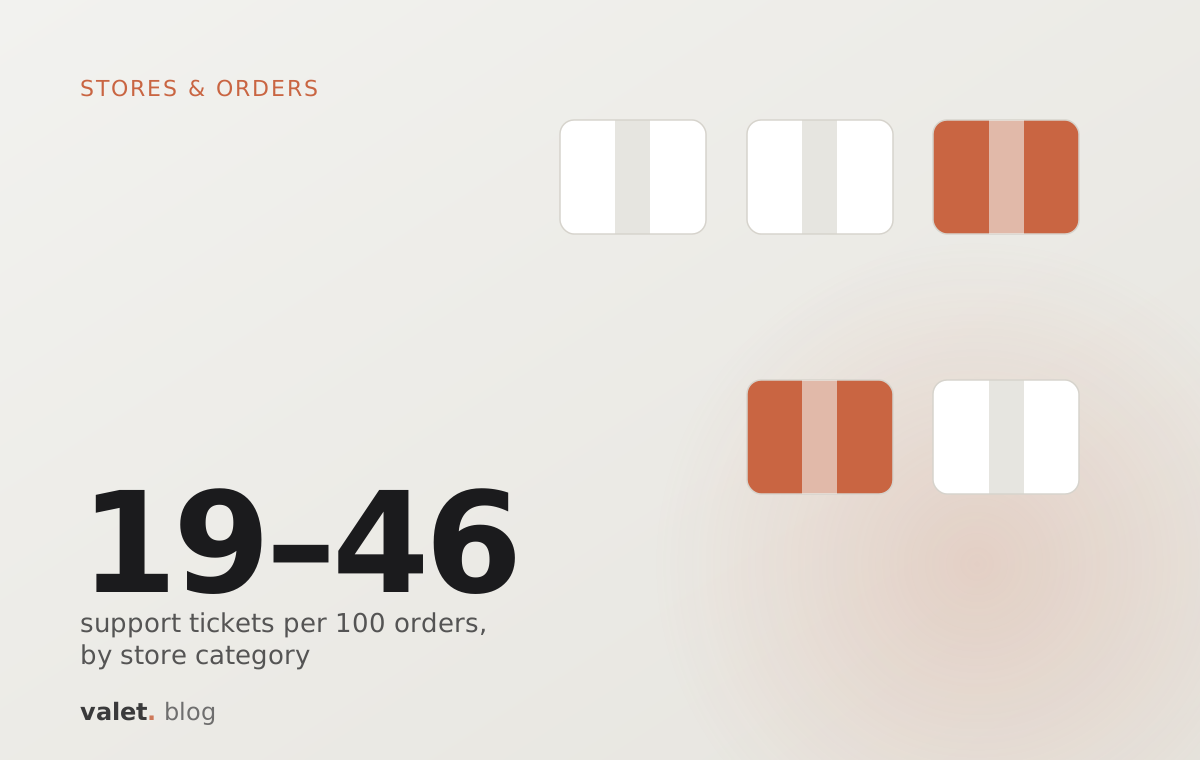
19–46
support tickets per 100 orders, by store category
Gorgias Ecom Lab, March 2026 data
$12.18
estimated cost of one human-handled ticket
Gorgias, November 2023 (vendor estimate)
55%
of AI-touched tickets ended in a human handoff; median wait after handoff 10 h
Gorgias Ecom Lab, Oct 2025–Apr 2026
Customer support costs a small online store about $2.30 to $5.60 in labour per order. The formula has two parts: tickets per 100 orders, which Gorgias's platform data puts at 19 to 46 depending on what you sell12, times the cost of one ticket, which Gorgias estimated at about $12.18 for a human-handled one3. A 300-order apparel store lands near $9.6k a year. A 1,000-order apparel store lands near $32k.
Most owners stop there, or they add AI and stop at the AI bill. The third term is the one that moves the answer: the handoff tax. At the median Gorgias brand, 55% of AI-touched tickets still ended with a person, and that person replied after a median of 10 hours4. This piece works through all three terms and ends with a calculator you can fill in from your own inbox.
How much does customer support cost per order?#
Support cost per order is tickets per order multiplied by cost per ticket. It is a unit-economics number, and it belongs next to shipping and payment fees in your margin sheet, not in a separate bucket called "overhead."
The decision behind it is a capital allocation decision, even in a one-person store. Every hour spent on "where is my order?" is an hour not spent on product, ads or suppliers. Every dollar spent on a helpdesk or an AI agent is a dollar not spent on stock. You cannot weigh those choices until you know what one order costs you in support.
Here is the arithmetic at Gorgias's 2023 estimate of $12.18 per human-handled ticket, which it described as roughly $12 of labour plus $0.18 to $0.40 of platform cost3:
| Category | Tickets per 100 orders | Labour per order | Per year at 300 orders/mo | Per year at 1,000 orders/mo |
|---|---|---|---|---|
| Toys & games | 19 | $2.31 | $8,331 | $27,770 |
| Food & beverages | 20 | $2.44 | $8,770 | $29,232 |
| Health & beauty | 21 | $2.56 | $9,208 | $30,694 |
| Apparel & accessories | 22 | $2.68 | $9,647 | $32,155 |
| Luggage, home & garden, sporting goods | 32 | $3.90 | $14,031 | $46,771 |
| Hardware | 41 | $4.99 | $17,978 | $59,926 |
| Electronics | 46 | $5.60 | $20,170 | $67,234 |
Tickets per 100 orders: Gorgias platform data, March 2026, published April and May 202612. Cost per ticket: Gorgias estimate, November 20233. Valet arithmetic; labour only, before helpdesk or AI fees.
How many tickets per 100 orders is normal?#
A normal ticket rate for an online store is somewhere between 19 and 46 per 100 orders, and the category you sell in decides most of it. Gorgias's Ecom Lab found "about 46 support tickets for every 100 orders" in electronics against "about 20" in food and beverages, using March 2026 data from accounts with at least 30 tickets1.
Two cautions apply before you use these numbers as your own. First, Gorgias reported the vertical comparison at a $10M GMV band1. A store doing $300k a year may run a different mix. Second, the benchmark counts tickets in a helpdesk, so it misses questions that never became tickets: the DM nobody logged, the contact form that went to a personal inbox.
The categories make sense once you look at what customers ask. Electronics buyers ask about compatibility and faults. Apparel buyers ask about fit and returns. Everyone asks where the order is. Gorgias's 2023 data put "where is my order" at 18% of incoming requests3. We have not found a 2024–2026 primary figure for that share, so treat it as a rough guide.
What does one support ticket cost a small store?#
One human-handled ticket cost about $12.18 to $12.40 in Gorgias's 2023 estimate3. That figure assumes paid staff. If you answer tickets yourself, the honest unit is your own time, priced at the value you put on an hour of it.
For example, an owner who spends 7 minutes per ticket and values an hour at $50 is spending about $5.83 per ticket. Neither number is a benchmark; both are inputs you set. The opportunity cost is the point. A founder's hour usually has a better use than typing a tracking link for the ninth time that day.
Gorgias's own worked example shows how the cost hides in plain sight. At 1,000 orders a month with 150 "where is my order" requests, it priced human handling at about $1,860 a month for that one question type3. That is a full headcount decision for a small store, made one email at a time.
Why the AI line on the bill looks so small#
AI pricing for store support is set per resolved conversation, and the unit price is low. Gorgias charges $0.90 per resolved interaction on most plans and $1.00 on starter plans5. Put that next to $12.18 for a human, and the spreadsheet almost writes itself.
The spreadsheet is compelling because the first half of it is true. Gorgias measured a median AI resolution rate of 45%, defined as the share of AI-touched tickets "closed without a human agent message," with the top quartile at 65%4. Brands automating close to nothing averaged 736-minute email response times6. Speed matters to revenue as well: Gorgias reported in May 2026 that AI-influenced pre-purchase orders carried a 45% higher average order value than the site average7.
So the board-approval version of the plan reads like this. Take a 300-order apparel store with 66 tickets a month. Let AI resolve 45% of them. That is 30 tickets at $0.90, or $27. The other 36 tickets cost $438 at $12.18. Monthly labour falls from about $804 to about $465, before the helpdesk subscription. Per order, support drops from $2.68 to about $1.55.
The unforced error is stopping there.
What is the handoff tax?#
The handoff tax is the cost of tickets an AI touches but does not finish. It has two parts: the human time to answer them, and the customers who leave while they wait. Neither part appears on the AI invoice, because Gorgias does not charge for "conversations resolved by a human agent"5, and the customer who leaves is never billed to anyone.
Gorgias's Ecom Lab measured the second part directly, across accounts with 200 or more AI-touched tickets between October 2025 and April 20264:
- 55% of AI-touched tickets ended in a human handoff.
- The median wait after handoff was 10 hours. The 90th percentile was 71 hours.
- One-third of handed-off tickets never received a human reply.
- Abandonment after handoff was 42% for contact forms, 30% for email and 13% for chat.
Run those rates through the same 300-order store. 36 tickets a month come back to a person. If most arrive by email, roughly 11 of those customers abandon the thread, and about 12 never get a human answer at all. Those are not support costs. They are refunds you will issue later, chargebacks you will fight, and second orders that never happen. You price them with your own average order value, not with $12.18.
Gorgias's conclusion from the same data is that "The only exit is fewer handoffs"4. That is one way out. The other is to make the handoff cheaper: tell the customer when a person will answer, carry the context so nobody re-asks, and keep the question in front of the owner until it is closed. A per-resolution bill pays for the first approach and ignores the second.
Watch the billing unit. A G2 reviewer (April 2026) described Gorgias's pricing as "based on ticket volume rather than a flat monthly fee," adding that "costs can increase significantly"8. Model your peak month, not your average one.
The per-order support calculator#
The calculator below has one row per input. Fill the left column with your own numbers from the last 90 days. The example column uses the 300-order apparel store from this article, and its labelled assumptions are ours, not benchmarks.
| Line | How to get it | Example (300 orders, apparel) |
|---|---|---|
| A. Orders per month | Your store admin | 300 |
| B. Tickets per 100 orders | Count support emails, forms and DMs for 90 days ÷ orders × 100; benchmark 19–46 | 22 |
| C. Tickets per month | A × B ÷ 100 | 66 |
| D. Cost per human ticket | Minutes per ticket ÷ 60 × hourly value, or $12.18 (Gorgias 2023) | $12.18 |
| E. AI resolution rate | Your vendor's report; median Gorgias brand 45% | 45% |
| F. AI price per resolution | Your vendor's pricing page | $0.90 |
| G. AI fees | C × E × F | $27 |
| H. Handed-off tickets | C × (1 − E) | 36 |
| I. Human cost of handoffs | H × D | $438 |
| J. Tickets abandoned after handoff | H × your channel's rate (email 30%, form 42%, chat 13%) | about 11 |
| K. Value at risk from abandoned tickets | J × share you think you lose × average order value | your estimate |
| L. Helpdesk subscription | Your plan | your plan |
| Support cost per order | (G + I + K + L) ÷ A | $1.55 + (K + L) ÷ 300 |
Rates: Gorgias Ecom Lab, March 2026 and Oct 2025–Apr 2026; ticket cost: Gorgias 2023 estimate. Line K is deliberately left to you.
Two lines matter more than the rest. Line B is your own ticket rate, and most owners have never counted it. Line K is the handoff tax in money, and no vendor will fill it in for you. If you want help counting line B, the method in the Lost Lead Audit works for support email as well as for sales inquiries.
How we price around the handoff tax at Valet#
We made three product decisions at Valet with this arithmetic in mind. They are trade-offs, and we name what each one costs.
- Every handoff carries a time. When a question goes to the owner, the customer is told when the owner will reply. That does not shorten the owner's day. It changes what the customer does while waiting, which is the part Gorgias's abandonment rates measure.
- Money waits for the owner. Discounts, refunds and complaints go to the owner with one-tap replies, by default. That raises the handoff count on purpose. We accept a higher line H to keep line K from including a refund the business never approved.
- The fee follows an outcome the owner can see. During early access, Valet is a small monthly base plus a fee only for bookings or quotes it wins, capped monthly. It is not billed per resolved conversation. The cost is that a quiet month earns us little, which we consider the right incentive.
The unresolved question is the one this calculator cannot answer for anyone else: what share of abandoned support threads turn into lost orders for a small store. No public dataset we have found measures it below Gorgias's 200-ticket threshold. Valet could measure it from free lead checks, by counting forwarded support threads that end with no reply and following what happened next. We have not published such a figure, and we will not quote one until we have.
Where Valet fits#
Valet is a small business's own AI assistant for written inquiries, and it is not a helpdesk. You forward support@ or hello@ to a private Valet address; there is nothing to migrate, and replies go out from your own address. It answers from the facts you write down, such as shipping times, the returns window and sizing notes, and anything not on your list waits for you. Every reply is signed as your assistant, says it is AI, and comes with a Valet receipt showing what was asked, the rule used and the sources used.
If you want to fill in line B with real numbers, the free lead check takes 10–20 recent inquiries and shows what went unanswered, what stopped after one reply, and what it was worth. For the after-hours side of the same problem, see the 53% of pre-sales questions that arrive after hours.
Questions people ask
How many support tickets does an online store get per 100 orders?
Gorgias's platform data for March 2026 ranges from about 19 tickets per 100 orders (toys and games) to about 46 (electronics). Apparel sits near 22 and food and beverage near 20. Your own count from the last 90 days is better than any benchmark.
What does one customer support ticket cost a small store?
Gorgias estimated in 2023 that a human-handled ticket costs about $12.18 to $12.40, mostly labour. If you answer tickets yourself, multiply your minutes per ticket by the hourly value you put on your own time instead.
Does AI make customer support cheaper per order?
It lowers the labour line, but not by as much as the resolution rate suggests. At the median Gorgias brand, 45% of AI-touched tickets closed without a human message and 55% were handed to a person, who replied after a median of 10 hours. Price both halves.
What is the handoff tax in customer support?
It is the cost of tickets an AI touches but does not finish: the human time to answer them, plus the customers who give up while waiting. Gorgias found one-third of handed-off tickets never got a human reply, and 30% of email handoffs were abandoned.
Sources
Confidence: H primary source checked · M credible secondary or reported · L vendor claim or single report. Reddit and forum items are quoted from public threads and summarised, not endorsed.
- Stop benchmarking against the average · Gorgias Ecom Lab · 2026-04-01 H
- Ticket volume · Gorgias · 2026-05-22 H
- Automate WISMO requests · Gorgias · 2023-11-13 M
- The cheapest ticket is the one a human never touches · Gorgias Ecom Lab · 2026 H
- AI Agent pricing · Gorgias · 2026-05-28 H
- Customer service benchmarks · Gorgias · 2026-05-15 H
- Pre-purchase speed is a revenue lever most brands treat as a cost · Gorgias Ecom Lab · 2026-05 H
- Gorgias reviews · G2 · 2026-04-21 H
How to cite this page
Cite this page
Valet, "How much does customer support cost a small online store per order?", valet.team, October 2026.
Keep reading
 Stores & orders"Will this fit?" "Do you ship to Ireland?" The 53% of pre-sales questions that arrive after hours, and what they're worthGorgias's 2026 data puts a number on the shopper who asks at 10pm and buys elsewhere. Here is a worksheet to price that wait for your own store, and three ways the next 12 months could change it as AI shopping assistants start asking the questions.Trends desk · 11 min · 1 October 2026
 Stores & ordersHow to handle "where is my order" emails in a small store: answer from the order, act on it, stay until deliveredA tracking link answers the question a store expects. The email asks a different one: what is happening to my parcel, and what will you do about it. Here are the base rates, the five states behind the question, and the reply each one deserves.Trends desk · 8 min · 1 October 2026
 Stores & ordersThe 48 hours after "order confirmed": why the status page didn't stop the emails, and the three silent states behind themStores answer the post-purchase silence with a status page or a stream of automatic emails. Both are broadcasts. The emails keep coming because the customer is asking about one parcel in one of three states the page cannot explain.Trends desk · 8 min · 1 October 2026