
Stores & orders
Best AI customer service for a small Shopify store (2026): verified prices and the gap each leaves
Eight options priced for a 300-order store from pages read on 1 October 2026. The usual advice is to pick the lowest price per resolution. The better question is what happens to the 55% of conversations the AI hands back.
Short answer
For a small Shopify store doing about 300 orders a month, AI customer service costs roughly $0 (Shopify Inbox) to $119 a month at list prices read on 1 October 2026: Re:amaze about $50, Gorgias $46–77, Fin from $49.50 plus a helpdesk, Zendesk $92.50–119, Richpanel $105–112. Choose on what happens to handed-off conversations, not on price: at the median Gorgias brand, 55% of AI-touched tickets went to a person, who replied after a median of 10 hours.
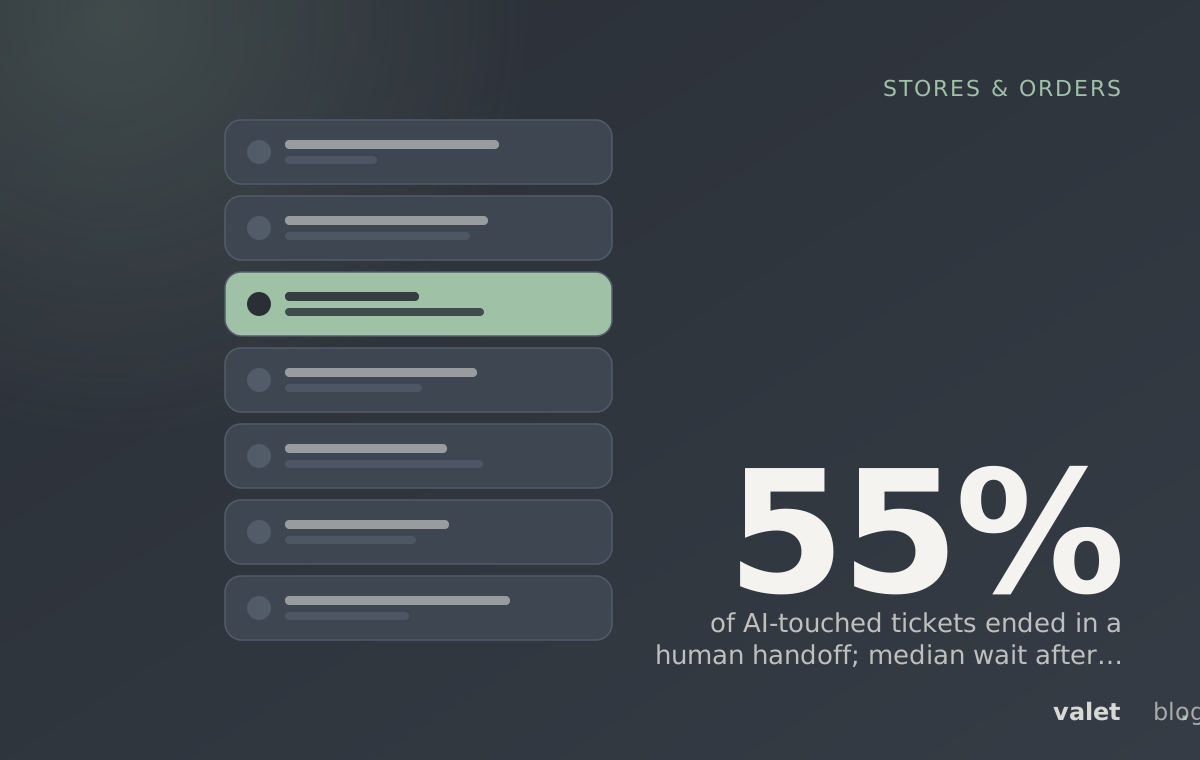
55%
of AI-touched tickets ended in a human handoff; median wait after handoff 10 h
Gorgias Ecom Lab, Oct 2025–Apr 2026
1 in 3
handed-off tickets never received a human reply
Gorgias Ecom Lab, Oct 2025–Apr 2026
$0.20–2.00
range of per-conversation or per-resolution AI fees across the vendors compared
vendor pricing pages, read 1 Oct 2026
For a small Shopify store doing about 300 orders a month, AI customer service costs between nothing and about $119 a month at list prices read on 1 October 2026. Shopify Inbox is free; Gorgias comes to about $46–77, Re:amaze about $50, Fin from $49.50 plus a helpdesk, Zendesk $92.50–119 and Richpanel $105–112. Those totals are the wrong basis for the choice. At the median Gorgias brand, 55% of AI-touched tickets ended with a person, who replied after a median of 10 hours1. The best tool for a small store is the one whose handed-back conversations cost you least, and no pricing page shows that number.
The usual advice: pick the lowest price per resolution#
The consensus on AI support for small stores runs as follows, and it deserves to be stated in its strongest form before anyone argues with it. A human-handled ticket costs about $12 in labour, by Gorgias's 2023 estimate15; an AI resolution costs between $0.20 and $2.00; the AI answers in seconds at 3am; and so the rational buyer finds the tool with the lowest effective price per resolution at their volume, connects it to Shopify, and lets it absorb as much of the queue as it can.
Every vendor in this comparison sells some version of that logic, and the arithmetic supports it. Gorgias charges $0.90 per resolved interaction on most plans2. Zendesk includes five automated resolutions per agent and charges $1.50 to $2.00 for each one after that4. Fin charges $0.99 per outcome5. Against a $12 ticket, any of them looks like margin.
Why smart, well-incentivised people believe it#
The consensus is held by people who have looked at real data, and the data they looked at is good. Gorgias measured a median AI resolution rate of 45% across its brands, with the top quartile at 65%1. In its May 2026 research on pre-purchase questions, AI answered 98% within five minutes against 13% for human teams, and AI-influenced pre-purchase orders carried a 45% higher average order value than the site average12.
Speed matters most when the store is asleep, which for a one-person store is most of the time. A small business that previously answered after a day now answers in under a minute for nearly half its tickets. On a margin sheet that reads like a headcount decision avoided, and for many stores it is exactly that.
The owners complaining about these tools are not, for the most part, complaining that the AI fails to answer. They are complaining about the bill. A thread in r/CRMSoftware (20+ comments, about September 2026) notes that "pay-per-resolution pricing can get expensive fast." Another in r/AI_Customer_Support (20+ comments, about August 2026) calls metered billing "unpredictable." The natural response is to shop for a lower unit price, which keeps the consensus intact.
The cracked assumption: the unresolved half costs what it cost before#
The consensus quietly assumes that the conversations the AI does not finish cost the business what they cost before the AI arrived: one human ticket each, answered on the usual schedule. That assumption fails, and Gorgias's own data shows how.
Across accounts with 200 or more AI-touched tickets between October 2025 and April 2026, Gorgias found that 55% of AI-touched tickets ended in a human handoff; that the median wait after handoff was 10 hours and the 90th percentile 71 hours; that one-third of handed-off tickets never received a human reply; and that 42% of contact-form handoffs, 30% of email handoffs and 13% of chat handoffs were abandoned1. A ticket that waits 10 hours after a bot has already answered it is a worse experience than a ticket that simply waited, because the customer has been told, in effect, that someone is coming.
The billing definitions make the second-order effect worse. Gorgias bills when the AI "resolves a customer conversation entirely on its own"2. Fin counts a resolution when "No further help is requested after Fin's last answer"5. On Hacker News in June 2026, one commenter called that "A very soft resolution metric," because it counts a customer who simply stops replying13. A small-business reviewer on G2 described the same "gray area around the 'assumed resolved' conversations that you are being charged for"14.
This is a principal-agent problem, and it is nobody's bad faith. The vendor is paid when the AI closes a conversation without a human message. The owner is paid when the customer gets an answer and buys again. Those two outcomes overlap most of the time and diverge exactly in the handoff tail, which is where the vendor earns nothing and the owner loses the most.
The alternative in one sentence#
For a small store, the cost of AI customer service is set by what happens to the conversations it does not finish, so price the handoff first and the resolution second.
Gorgias draws a different conclusion from the same data: "The only exit is fewer handoffs"1. For a store with a support team that is a reasonable local optimum. For a one-person store, fewer handoffs means letting the AI answer refund, discount and complaint questions it should not answer alone. The other exit is a better handoff: the customer is told when a person will reply, the context travels with the question, and the question stays visible until someone closes it.
Eight options, priced for a 300-order store#
The table below prices each option for an apparel store with 300 orders a month. Gorgias's March 2026 data puts apparel at about 22 tickets per 100 orders11, so that is 66 conversations, of which we assume 30 are resolved by AI at the 45% median. Prices are list prices from each vendor's page, read on 1 October 2026; the capability column records only what those pages state.
| Option | List price (verbatim where possible) | Monthly at 300 orders | Billing unit | What happens to the other 55% |
|---|---|---|---|---|
| Shopify Inbox | "a free messaging app"; AI-suggested answers10 | $0 | None | Chat-first; the owner answers what the suggestions do not. Whether it takes in a support@ address, we could not confirm. |
| Gorgias | Starter $10 / 50 tickets, Basic $50 / 300 tickets (G2 listing)3; AI "$0.90 per resolved interaction," $1.00 on starter plans2 | $46.40–77 | Resolved interaction | Handed to your helpdesk queue; you move support@ in and write rules first. |
| Re:amaze | Basic $29 per team member; "5 resolutions per month per user included. $0.85 per additional resolution"9 | about $50 | Resolution | Handed to your helpdesk queue; migration as above. |
| Fin (formerly Intercom) | "$0.99 per outcome," "50 outcomes per month minimum"5; Intercom helpdesk seat from $296 | $49.50 with your own helpdesk; $78.50 with one Intercom seat | Outcome ("No further help is requested…") | Handed to the helpdesk you connect; the minimum means 30 outcomes are billed as 50. |
| Tidio (Lyro) | Lyro "from $32.50" for 50 Lyro AI conversations; Starter $24.17, Growth from $49.17; "Native Shopify actions" from Growth7 | from $32.50, plus a plan if needed; 66 conversations exceed the entry block | Conversation (standard plans) | Handed to Tidio's inbox; billed per conversation whether or not it is resolved. |
| Zendesk Suite Team | $55 per agent annual ($69 monthly); 5 automated resolutions included; extra $1.50 committed or $2.00 pay-as-you-go4 | $92.50–119 | Automated resolution | Handed to your agent seat; each new helper is another seat. |
| Richpanel | "$99 per seat, per month"; "$0.20 per AI handled conversation"8 | $105–112 | AI-handled conversation | Handed to your seat; billed for AI handling whether or not it resolves. |
| DIY (n8n or Zapier plus an AI model) | No list price; your build and upkeep hours plus usage fees | Your hours | None | Whatever you build. No inquiry state, no rules for money, no reply-by time unless you add them. |
Valet arithmetic from each vendor's pricing page as cited, read 1 October 2026; Gorgias helpdesk tiers from G2 because Gorgias's own table did not render. Gorgias, Re:amaze and Zendesk figures assume no larger included AI block than stated. Richpanel range: 30 to 66 AI-handled conversations.
Two readings of the table matter more than the ranking. First, the price spread at this volume is about $120 a month, which is roughly the labour cost of ten handed-back tickets at Gorgias's 2023 estimate of about $12 each15. Second, the last column is nearly identical down the page. Every paid option sends the unresolved conversation to a queue that you staff.
Three lines of evidence, strongest last#
The definitions. The billing unit varies from a resolution (Gorgias, Re:amaze, Zendesk) to an outcome with a monthly minimum (Fin) to any AI-handled conversation (Richpanel, Tidio's standard Lyro plans). None of the pages we read prices the handoff, and none publishes a reply-by promise for it. For the full side-by-side of definitions, see what counts as an AI resolution.
The bills. The owner threads we found mostly cite cost growth rather than answer quality. A thread in r/ecommerce (20+ comments, about August 2026) asking about Gorgias and Zendesk AI agents includes the line "Zendesk is becoming too expensive for our company." That is snippet-grade evidence, and it points the same way as the r/CRMSoftware and r/AI_Customer_Support threads above.
The handoff data. The strongest evidence comes from the vendor with the most to lose by publishing it. Gorgias's own figures show that after a handoff the median customer waits 10 hours, the slowest tenth wait about three days, and a third get no human reply at all1. Any tool that hands back the same share into the same owner's queue inherits those numbers, whatever its price per resolution.
Where the consensus still wins#
The lowest-price-per-resolution rule is right in three situations, and a fair comparison has to say so. If most of your conversations happen in chat, handoff abandonment is lowest there (13% in Gorgias's data1), and Shopify Inbox is free and built for that channel; Shopify says 70% of Inbox conversations "are with customers making a purchasing decision"10. If you already have someone covering the queue within the hour, the handoff tail is short and the bill is the main variable. And if you are near 1,000 orders a month with two or more people, a helpdesk's queue and assignment features solve a coordination cost that a one-person store does not have yet.
Where I'd be wrong, and the Monday-morning decision#
This argument fails if your own handoff tail is short. If your handed-off conversations are answered within an hour and few are abandoned, the cracked assumption holds for you, and you should pick on price. The test takes one export: pull the last 90 days of AI-touched conversations, mark which ones went to a person, and measure how long each waited and whether the customer replied again.
| If you believe | You will choose | Check this first | If the check fails, choose instead |
|---|---|---|---|
| The cheapest resolution wins | Lowest effective price at your volume | Median wait after handoff in your own data | The option with the shortest, stated handoff time |
| AI will absorb most of the queue | Per-resolution billing | Your projected handoff rate, not the vendor's top quartile | A model with a predictable monthly cost |
| A helpdesk is the next step for a store | Gorgias, Zendesk, Re:amaze or Richpanel | Do you have two or more people sharing the queue? | Keep support@ where it is and add answering from your policies |
| Chat is where customers ask | Shopify Inbox or Tidio | Share of questions arriving by email and contact form | Something that covers email, where abandonment after handoff is 30–42% |
| A resolution means the customer was helped | Whatever the dashboard reports | The vendor's billing definition, verbatim | A tool whose billed outcome you can verify yourself |
Where Valet fits#
Valet is not on the list above because it is not a helpdesk. It is a small business's own AI assistant for written inquiries: you forward support@ or hello@ to it, nothing migrates, and replies go out from your own address. It answers only from the facts you write down; refunds, discounts and complaints go to you with one-tap replies, and the customer is told when you will reply. Every reply says it is AI and carries a Valet receipt. During early access it is a small monthly base plus a fee only for bookings or quotes it wins, capped monthly.
If you want to see your own handoff tail before choosing any tool, the free lead check takes 10–20 recent inquiries and shows what went unanswered, what stopped after one reply, and what it was worth. The two-tool version of this comparison is Gorgias vs Zendesk for a small store.
Questions people ask
What is the cheapest AI customer service for a small Shopify store?
Shopify Inbox is free and includes AI-suggested answers for chat. Among paid tools at about 300 orders a month, Gorgias Starter (about $46) and Re:amaze Basic (about $50) came out lowest in our arithmetic from list prices read on 1 October 2026. Check what each one counts as a billable resolution first.
What is a good alternative to Gorgias for a small store?
Re:amaze, Tidio and Shopify Inbox cost less or similar at small volumes; Zendesk and Richpanel cost more. All of them are answer-first tools that hand unresolved conversations to you. If you do not want a helpdesk at all, look for something that answers from your own policies and tells the customer when you will reply.
Is Shopify Inbox enough for customer service?
For live chat on a small store it may be. Shopify says 70% of Inbox conversations are with customers making a purchasing decision, and it suggests AI answers. We could not confirm from Shopify's page whether it takes in a support@ email address, so check that before relying on it for email.
Why does per-resolution pricing get expensive?
Because the bill grows with volume and the definition of a resolution is set by the vendor. Fin, for example, counts a resolution when no further help is requested after its last answer, which includes customers who simply stopped replying.
Sources
Confidence: H primary source checked · M credible secondary or reported · L vendor claim or single report. Reddit and forum items are quoted from public threads and summarised, not endorsed.
- The cheapest ticket is the one a human never touches · Gorgias Ecom Lab · 2026 H
- AI Agent pricing · Gorgias · 2026-05-28 H
- Gorgias pricing (plan listing) · G2 · 2026-10-01 M
- Zendesk pricing · Zendesk · 2026-10-01 H
- Fin pricing · Fin (formerly Intercom) · 2026-10-01 H
- Intercom pricing · Intercom · 2026-10-01 H
- Tidio pricing · Tidio · 2026-10-01 H
- Richpanel pricing · Richpanel · 2026-10-01 H
- Re:amaze pricing · Re:amaze · 2026-10-01 H
- Shopify Inbox · Shopify · 2026-10-01 H
- Stop benchmarking against the average · Gorgias Ecom Lab · 2026-04-01 H
- Pre-purchase speed is a revenue lever most brands treat as a cost · Gorgias Ecom Lab · 2026-05 H
- Hacker News discussion (comment by tcp_handshaker, item 48542155) · Hacker News · 2026-06-15 H
- Intercom reviews (cons) · G2 · 2026-06 H
- Automate WISMO requests · Gorgias · 2023-11-13 M
How to cite this page
Cite this page
Valet, "Best AI customer service for a small Shopify store (2026): verified prices and the gap each leaves", valet.team, October 2026.
Keep reading
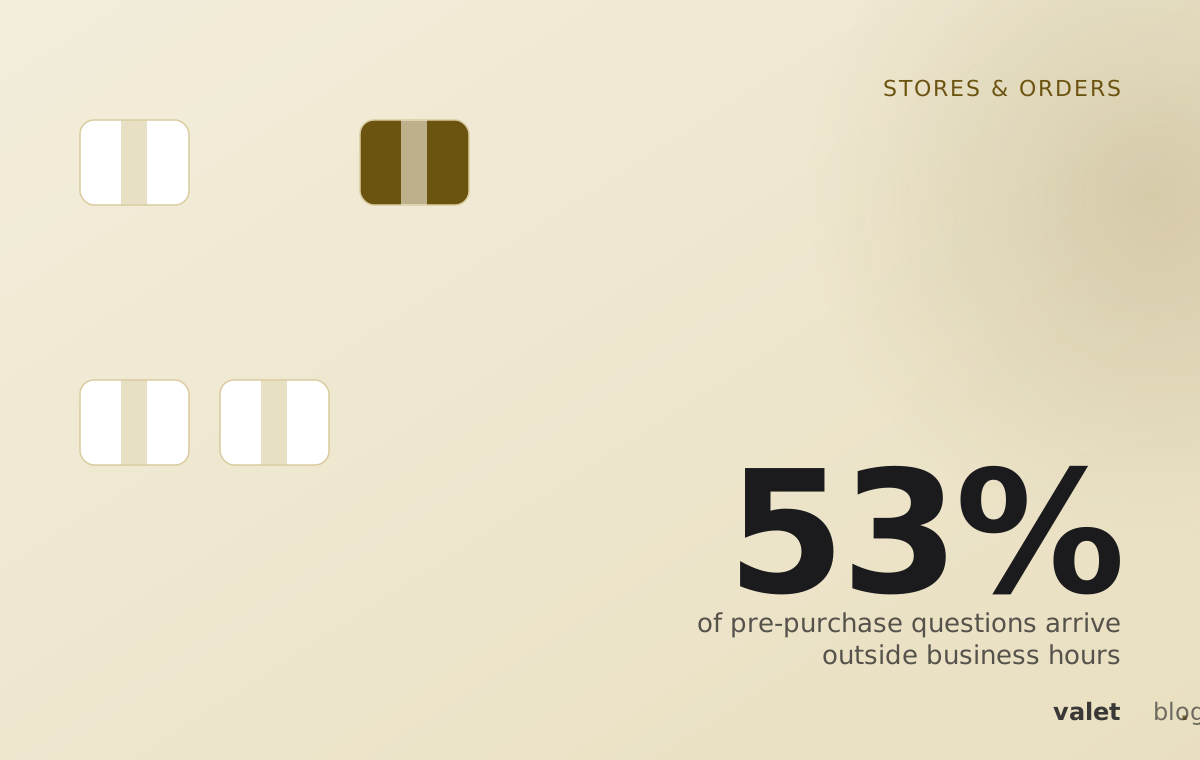 Stores & orders"Will this fit?" "Do you ship to Ireland?" The 53% of pre-sales questions that arrive after hours, and what they're worthGorgias's 2026 data puts a number on the shopper who asks at 10pm and buys elsewhere. Here is a worksheet to price that wait for your own store, and three ways the next 12 months could change it as AI shopping assistants start asking the questions.Trends desk · 11 min · 1 October 2026
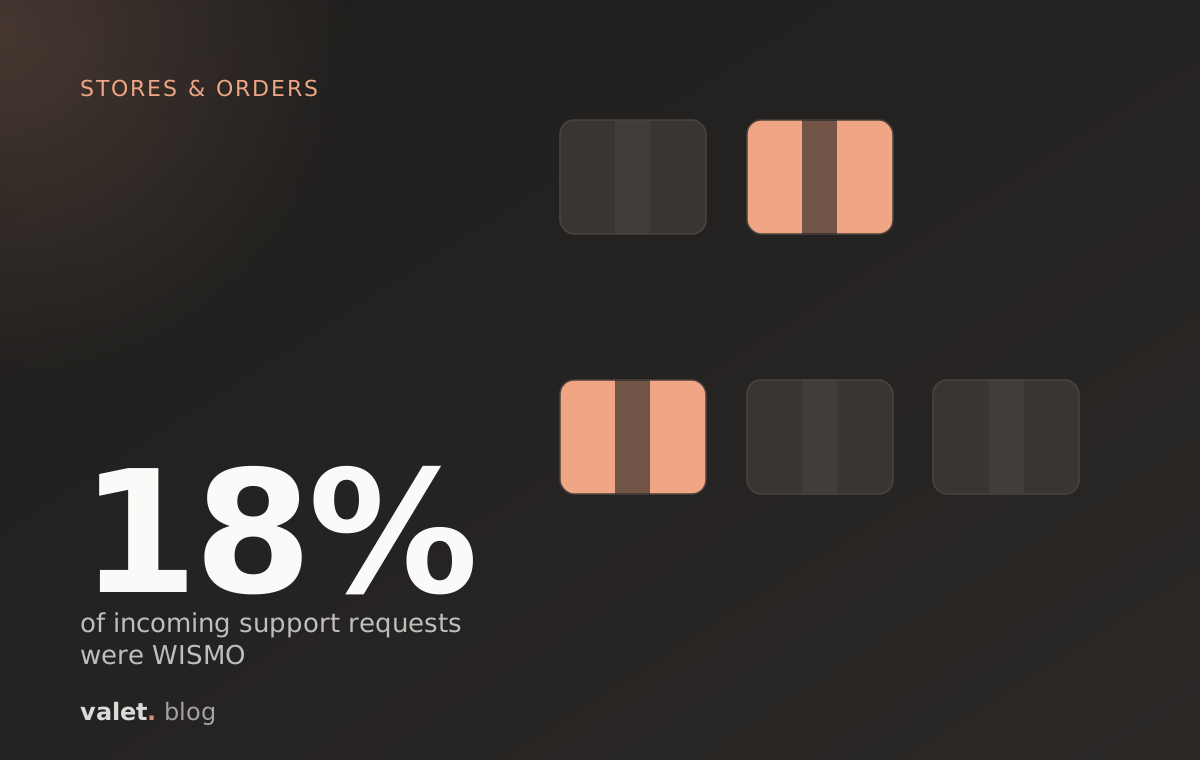 Stores & ordersHow to handle "where is my order" emails in a small store: answer from the order, act on it, stay until deliveredA tracking link answers the question a store expects. The email asks a different one: what is happening to my parcel, and what will you do about it. Here are the base rates, the five states behind the question, and the reply each one deserves.Trends desk · 8 min · 1 October 2026
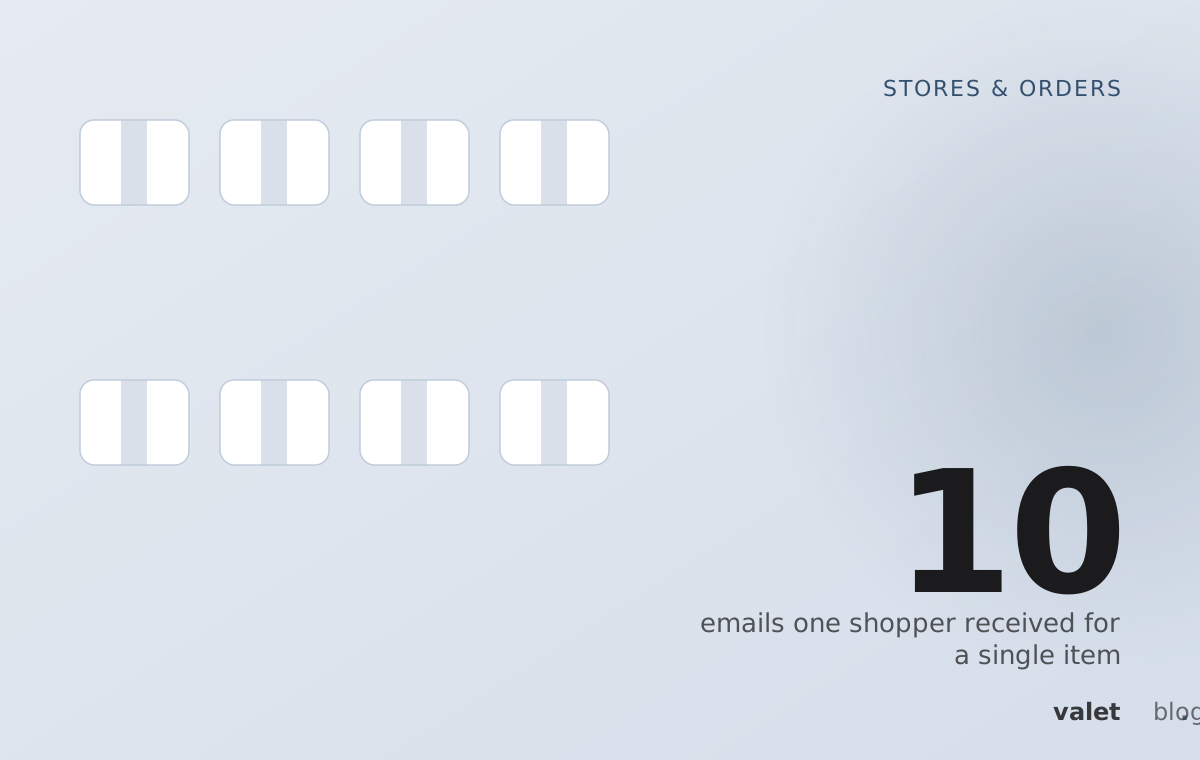 Stores & ordersThe 48 hours after "order confirmed": why the status page didn't stop the emails, and the three silent states behind themStores answer the post-purchase silence with a status page or a stream of automatic emails. Both are broadcasts. The emails keep coming because the customer is asking about one parcel in one of three states the page cannot explain.Trends desk · 8 min · 1 October 2026